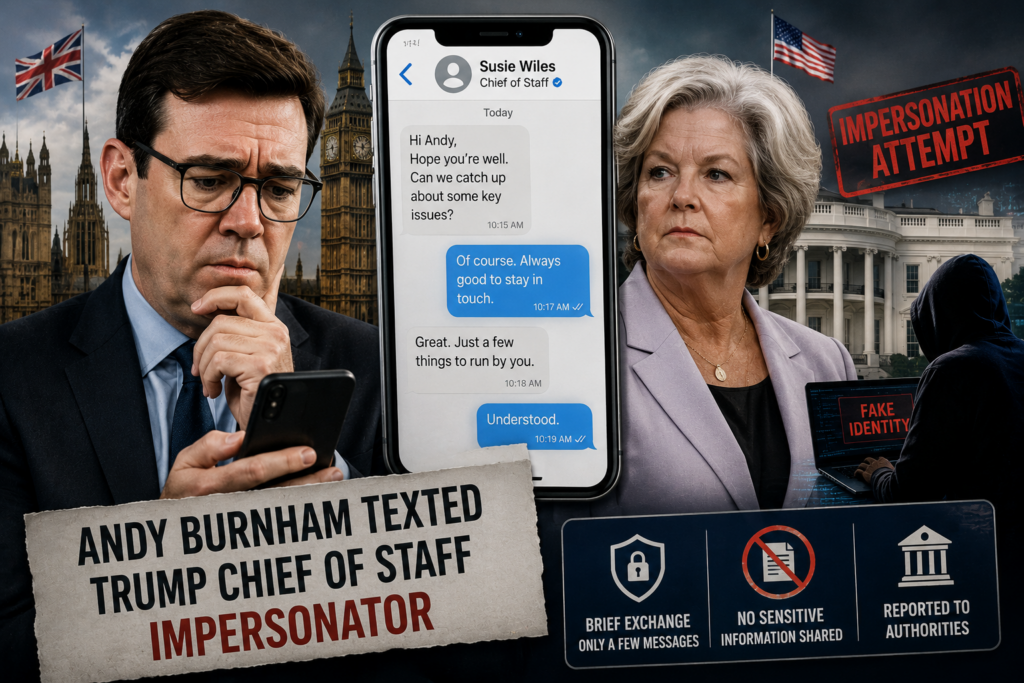
U.K. Prime Minister Andy Burnham exchanged messages with someone impersonating U.S. President Donald Trump’s chief of staff, Susie Wiles, in a security incident that was quickly reported to authorities. Officials said only a few messages were exchanged and that no significant information was disclosed.
According to a report by BBC News, Burnham became suspicious that the contact was illegitimate before communications ended. Downing Street declined to comment on the matter, citing national security considerations. The Associated Press separately reported that the White House confirmed the incident did not involve a new breach of Wiles’ devices.
What Happened?
Burnham communicated by message with a person claiming to be Susie Wiles, a senior White House official and Trump’s chief of staff.
The exchange reportedly occurred after Burnham became Britain’s prime minister. Officials familiar with the incident said only a few messages were exchanged before concerns arose about the identity of the person on the other end.
The communications were conducted through messages rather than a phone or video call. Sources said no messages of significance were exchanged and that the suspicious activity was quickly reported to the appropriate authorities.
Downing Street said it does not comment on national security matters and has not publicly disclosed when the messages were sent, how many were exchanged or which messaging platform was involved.
White House Says Wiles Was Not Hacked Again
The incident initially raised concerns that Wiles’ communications could have been compromised again.
A White House official told the BBC that the latest incident had “nothing to do” with Wiles’ phone being hacked. The clarification is significant because Wiles was previously targeted in a separate incident involving the misuse of her personal phone contacts.
In that earlier case, an impersonator or impersonators used contacts associated with Wiles to reach prominent U.S. officials, senators, governors and business executives while pretending to be the White House chief of staff.
The FBI investigated that earlier incident.
The latest episode therefore appears to involve impersonation rather than a newly confirmed compromise of Wiles’ phone.
Why Susie Wiles Was Targeted
Wiles is one of Trump’s closest political advisers and serves as his White House chief of staff, making her identity particularly valuable to someone attempting to establish credibility with senior political figures.
The incident involving Burnham demonstrates how impersonation can exploit existing relationships between senior officials.
Rather than needing to directly compromise a government system, an attacker can attempt to convince a target that they are communicating with a trusted political figure.
The episode comes as governments continue to face increasingly sophisticated cyber and social-engineering threats. The White House has previously dealt with concerns involving attempts to impersonate senior officials.
For additional context on Trump’s senior White House leadership, readers can also review the administration’s changes involving White House Counsel Will Scharf.
Previous Security Incidents Involving Wiles
The Burnham incident follows a previous security episode involving Wiles’ personal phone.
The BBC reported that Wiles said her phone had been hacked after someone gained access to her contacts and used them to message other prominent figures while impersonating her.
The recipients included senior U.S. officials and business leaders. The incident prompted an FBI investigation.
Wiles had also previously been targeted by a cyber espionage unit associated with Iran’s Islamic Revolutionary Guard Corps in 2024, according to the BBC’s reporting.
The latest impersonation attempt has renewed attention on the security challenges surrounding communications between senior government officials.
Other British Officials Have Faced Impersonation Attempts
The Burnham incident is not the first time a senior British politician has been targeted by someone pretending to be a foreign political leader.
In 2024, then-Foreign Secretary David Cameron became involved in a hoax communication with someone posing as former Ukrainian President Petro Poroshenko.
Cameron also exchanged text messages with the impersonator before becoming suspicious. Britain’s Foreign Office later disclosed details of the incident because officials feared the exchange could potentially be manipulated.
Two British government ministers were also targeted in 2022 by someone impersonating Ukrainian Prime Minister Denys Shmyhal. The calls were conducted through Microsoft Teams and were described at the time as relatively sophisticated.
These previous cases demonstrate that impersonation of senior international figures has repeatedly been used to target government officials.
Broader U.S.-U.K. Security Concerns
The incident involving Burnham comes as the U.S. and U.K. maintain close diplomatic and security relationships.
Any attempt to impersonate a senior White House official can create concerns beyond the individual messages because communications between political leaders may involve sensitive diplomatic or policy matters.
In this case, however, officials stressed that the exchange was brief and that no significant information was communicated.
The incident also does not appear to indicate that Wiles’ phone was newly compromised. The White House specifically separated the Burnham communications from the earlier hacking incident involving her personal device.
The Trump administration continues to face a range of international security challenges, including tensions involving Iran and other geopolitical rivals. Readers following the administration’s foreign-policy agenda can also see its broader approach in coverage of the Trump administration’s Colombia security package.
What Happens Next?
Downing Street has not provided details about the messages or whether additional security measures will follow.
The immediate response was to report the suspicious communications to the appropriate authorities. The White House has also indicated that the episode was not connected to a new compromise of Wiles’ phone.
For governments, however, the incident highlights the continuing challenge of verifying digital identities at the highest levels of international politics.
The Burnham episode ultimately involved only a few messages and no reported exchange of sensitive information, but it underscores how a convincing impersonation of a trusted official can quickly become a national security concern.
Burnham believed he was communicating with Susie Wiles, White House chief of staff to President Donald Trump.
No. The White House said the Burnham incident was unrelated to the earlier hacking of Wiles’ personal phone.