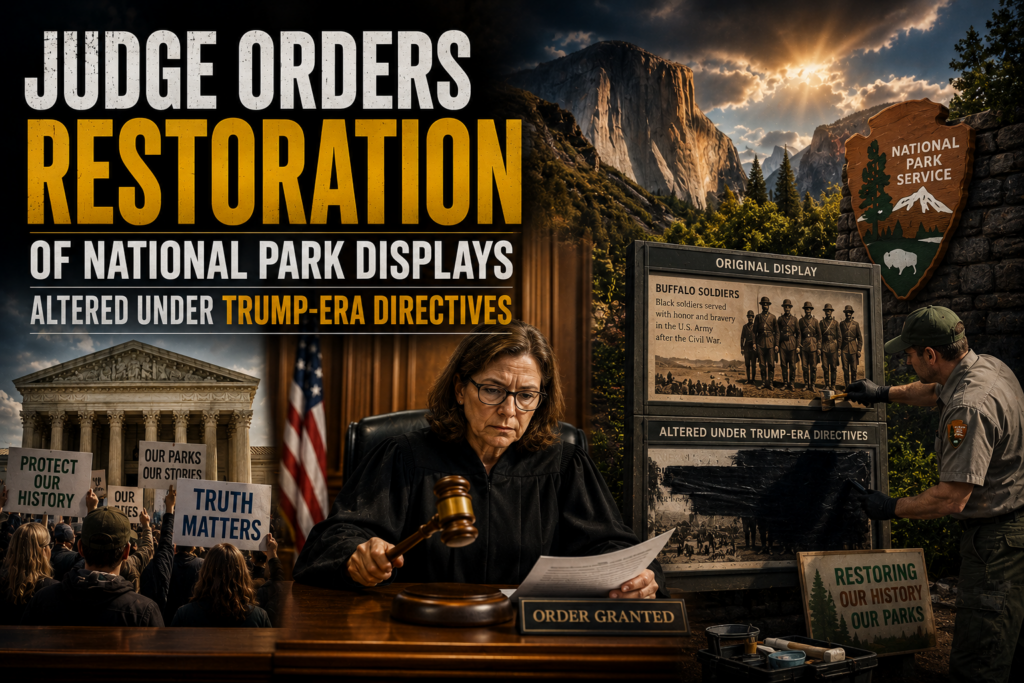
A federal judge has ordered the Trump administration to restore dozens of national park displays that officials altered or removed under a controversial executive order. The ruling marks a significant setback for the administration and could shape future debates about how public institutions present American history.
According to a report by CNN, U.S. District Judge Angel Kelley directed federal agencies to restore all affected exhibits before July 3, just days before America’s 250th anniversary celebrations.
What Happened
Judge Angel Kelley issued a 63-page ruling against the Interior Department and the National Park Service. She ordered both agencies to restore signs, displays, and exhibits that officials changed or removed under a 2025 executive order signed by President Donald Trump.
The executive order, titled Restoring Truth and Sanity to American History, instructed federal agencies to review historical content displayed on government property. Officials targeted exhibits they believed portrayed the United States negatively.
However, Kelley concluded that the policy removed important historical information. She also argued that the changes presented only part of the nation’s history.
Restoration Deadline Set
The court ordered federal agencies to complete restoration work by July 3.
In addition, the ruling prevents the administration from making further exhibit changes while the case continues.
As a result, national parks must return affected displays to their previous form unless a higher court intervenes.
Key Details Behind the Lawsuit
A coalition of conservation groups and historical advocates filed the lawsuit earlier this year.
The organizations accused the administration of removing important information about climate change, Native American history, slavery, and other topics.
They argued that national parks should present complete historical narratives rather than selective accounts.
Examples of Altered Displays
Court filings identified several displays affected by the policy.
At Grand Teton National Park in Wyoming, officials removed a marker discussing explorer Gustavus Cheyney Doane’s role in the massacre of at least 173 members of the Piegan Blackfeet Nation.
Meanwhile, officials removed a climate-related display at Fort Sumter National Monument in South Carolina. The exhibit explained how rising sea levels could threaten the historic site.
According to advocacy group Save Our Signs, officials altered or removed at least 45 displays nationwide.
Judge Says Parks Must Present Full History
Kelley stressed that national parks play a vital educational role.
She described the park system as a cornerstone of public learning. Therefore, she argued that visitors deserve access to complete historical information.
The judge criticized efforts to remove exhibits that did not align with a preferred narrative. In her view, national parks should present history in full rather than in fragments.
Furthermore, Kelley stated that government agencies have a responsibility to preserve historical accuracy for future generations.
Reactions From Both Sides
Conservation Groups Welcome the Decision
Conservation organizations praised the ruling.
Alan Spears of the National Parks Conservation Association called the decision a major victory for historical preservation. He said the ruling would help ensure visitors receive a complete understanding of American history.
Supporters of the lawsuit also argued that national parks serve as one of the country’s most important educational resources.
Trump Administration Signals Possible Appeal
The Interior Department strongly criticized the ruling.
A department spokesperson described Kelley as a “liberal activist judge” and suggested that officials may appeal the decision.
Nevertheless, the department has not announced its final legal strategy.
The dispute joins a growing list of legal challenges involving Trump administration policies. Similar debates have emerged over federal authority and government restructuring efforts, including changes affecting federal policy and career government positions.
Political and Cultural Impact
The ruling highlights a broader debate over how public institutions should present American history.
Supporters of the executive order argue that historical exhibits should emphasize national achievement and unity. Critics disagree. They believe removing difficult topics weakens public education and historical understanding.
Moreover, the case reflects wider disputes over the administration’s efforts to reshape government policies and public narratives.
Readers following broader policy developments may also be interested in Trump administration initiatives involving AI investment and emerging technologies.
Why National Parks Matter
National parks attract millions of visitors every year.
Many educators refer to them as America’s largest classroom. Visitors often rely on exhibits and interpretive displays to learn about important historical events.
Consequently, decisions about exhibit content carry significant educational and cultural importance.
What Happens Next
The Interior Department is expected to review possible appeal options in the coming weeks.
Unless a higher court blocks the order, federal agencies must restore all affected displays before July 3. They also must stop making additional changes covered by the ruling.
Ultimately, the case could establish an important legal precedent regarding government authority over historical interpretation.
Conclusion
The ruling delivers a significant legal setback for the Trump administration’s effort to reshape historical displays at national parks.
As the United States approaches its 250th anniversary, the decision has renewed debate over how public institutions should present the nation’s history. The outcome could influence future discussions about education, historical preservation, and government authority for years to come.
The court found that the changes removed important historical information and presented an incomplete account of American history.
The ruling requires restoration to be completed by July 3, 2026, before America’s 250th anniversary celebrations.