MAHA and MAGA are related but distinct: MAGA is the broad political movement built around Donald Trump's "Make America Great Again" platform, while MAHA ("Make America Healthy Again") is a narrower health and food policy campaign that grew inside that coalition. This guide to maha vs maga differences explained covers where the two overlap, where they diverge, and why the gap between them matters for the presidency, Congress and federal policy in 2026.
What Each Acronym Stands For
MAGA stands for "Make America Great Again," and MAHA stands for "Make America Healthy Again." The similarity in wording is deliberate, since MAHA borrows the branding of the larger movement to signal that it belongs to the same political family.
Here is the simplest way to separate them:
- MAGA is an umbrella political identity covering immigration, trade, foreign policy, judicial appointments, cultural issues and loyalty to Donald Trump.
- MAHA is a policy-focused movement concentrating on childhood chronic disease, food additives, ultra-processed foods, vaccines, and the influence of industry on federal health agencies.
MAGA describes who a voter is aligned with. MAHA describes what a voter wants done on a specific set of issues. A person can hold both identities, but many people hold only one, and that distinction drives most of the debate over the two labels.
For a deeper look at the larger movement's recent trajectory, see this analysis of MAGA movement growth in 2026.
Origins and Leadership
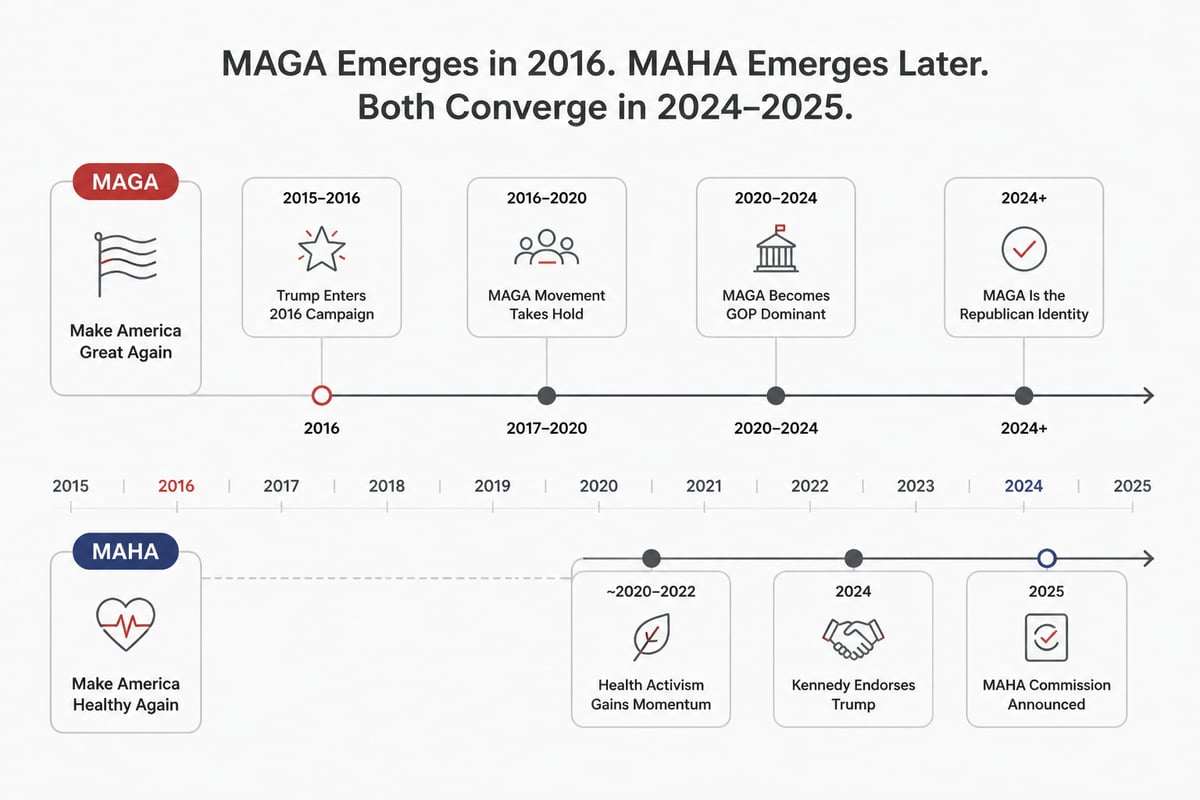
MAGA predates MAHA by roughly a decade and is anchored in Donald Trump's political rise, while MAHA emerged later as a health-focused current led most visibly by Robert F. Kennedy Jr.
MAGA took shape around the 2016 presidential campaign and has since become the defining force inside the Republican Party. Its institutions include campaign operations, aligned media outlets, endorsement networks and a large base of volunteers.
MAHA grew out of health freedom activism, parental concerns about food and chemicals, and skepticism toward public health institutions. Its profile rose after Kennedy, an independent presidential candidate in 2024, endorsed Trump and later became Secretary of Health and Human Services. That appointment moved MAHA from an activist label to an organizing principle inside the executive branch.
Readers tracking the movement's grassroots side can find more in this report on MAHA grassroots movement growth in 2026.
Policy Priorities Side by Side
The two movements prioritize different policy areas, and the clearest way to see this is a direct comparison of their core agendas.
| Area | MAGA | MAHA |
|---|---|---|
| Core focus | National identity, sovereignty, economic nationalism | Chronic disease, food quality, environmental exposures |
| Signature issues | Border security, tariffs, deportation, judicial appointments | Ultra-processed foods, food dyes, school meals, vaccine policy |
| Main federal levers | DHS, Treasury, Commerce, courts | HHS, FDA, USDA, CDC, NIH |
| Typical messaging | "America First" | "Healthy kids, clean food" |
| Relationship to industry | Generally pro-business, favors deregulation | Skeptical of food, pharma and chemical lobbying |
That final row is the sharpest policy contrast. MAGA's economic agenda generally favors lighter regulation, which is the posture America First economic policy tends to reflect. MAHA frequently calls for tighter rules on food ingredients and closer scrutiny of corporate influence over health agencies.
The "main federal levers" row explains why the two agendas rarely compete for the same resources. A tariff decision runs through Treasury and Commerce, and a deportation policy runs through DHS. A change to school meal standards, by contrast, runs through USDA, while questions about food chemicals and infant formula standards fall to FDA and HHS. Because the departments differ, progress on one agenda does not automatically help or hinder the other. The areas where they do intersect tend to be budget and personnel: both movements need appropriations, and both depend on political appointees who share their priorities.
The signature issues also differ in how measurable they are. Border and trade policy produce visible numbers quickly, such as enforcement figures and tariff rates. MAHA's targets, including childhood chronic disease, are long-horizon outcomes that cannot be judged by a single year of data. That is one reason the MAHA agenda leans so heavily on process milestones, such as proposed rules, revised guidelines and new labeling requirements, as its early evidence of progress.
The MAHA Commission and Its Official Agenda
MAHA moved from slogan to federal policy through the President's Make America Healthy Again Commission, which gives the movement a documented agenda that MAGA as a whole does not have in a single place.
The commission was established by executive order on February 13, 2025 and is chaired by the Secretary of Health and Human Services. Its output so far includes:
- A May 22, 2025 report that called for further research and education on diet, environmental exposures, physical inactivity and overmedicalization as possible contributors to chronic health problems, as described by USDA.
- A September 9, 2025 strategy listing more than 120 initiatives focused on childhood chronic disease, according to USDA’s Food and Nutrition Service.
- Proposed actions on dietary guidelines, food labeling, ultra-processed foods, infant formula standards, school meals and food chemicals, also outlined by USDA's Food and Nutrition Service.
The administration's own summary of the agenda and related initiatives sits on the HHS MAHA hub. For plain-language context on what the agenda includes and how it is being implemented, see this explainer on the MAHA agenda in 2026.
Voters and Coalitions
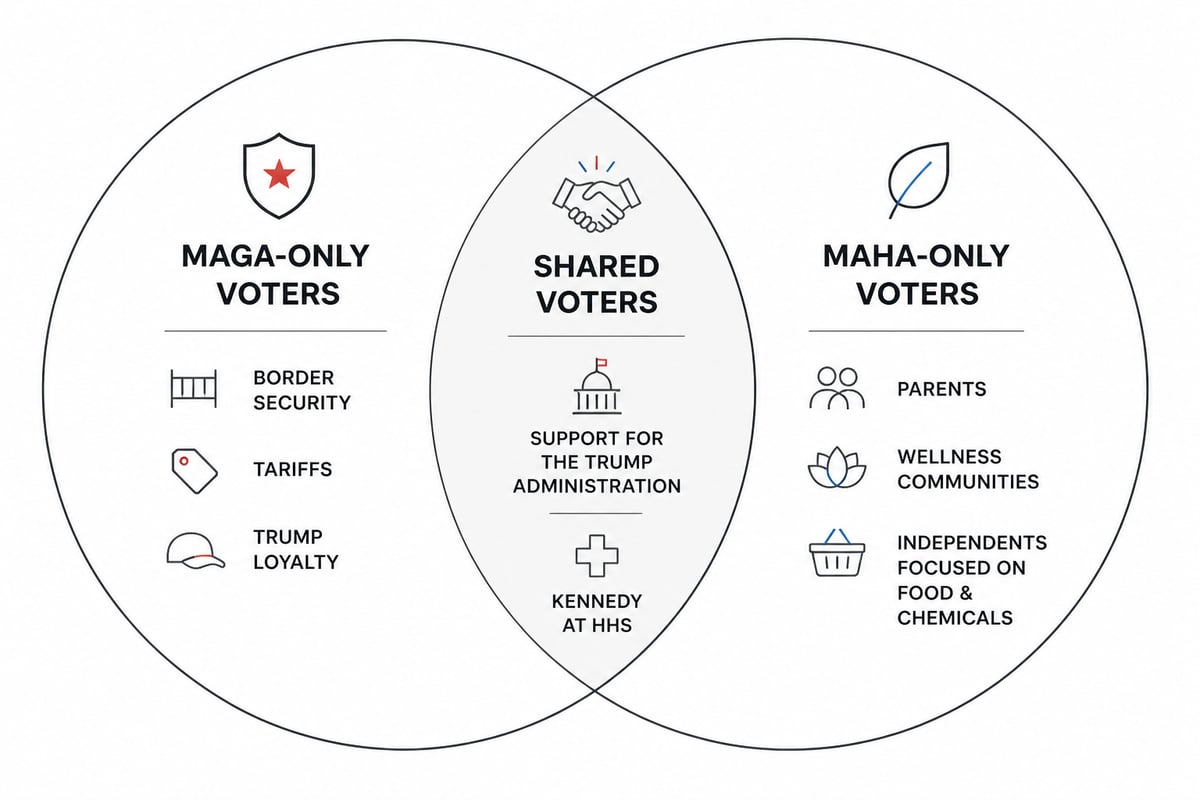
The people who identify with each label overlap heavily but are not identical, and the difference shows up in who each movement can mobilize.
MAGA's base is defined by strong loyalty to Trump, concern about immigration and the border, and a populist view of the economy. That base is large, organized and reliably Republican in primaries and general elections. Its influence on candidate selection is a recurring theme in coverage of MAGA endorsement impact in the 2026 midterms.
MAHA's audience is broader in some respects and narrower in others:
- Parents worried about childhood obesity, allergies, autism and diet-related illness.
- Wellness and natural health communities, some of which have not historically voted Republican.
- Independents and former Democrats drawn by food safety and anti-corporate arguments.
- Health freedom advocates focused on medical choice and vaccine policy.
This is the central coalition question. MAHA can bring new voters toward the Republican coalition, but it can also introduce demands that sit uneasily with the party's traditional business wing. Whether those voters turn out in 2026 depends on whether the movement's priorities show up in concrete federal action.
Where the Two Movements Clash
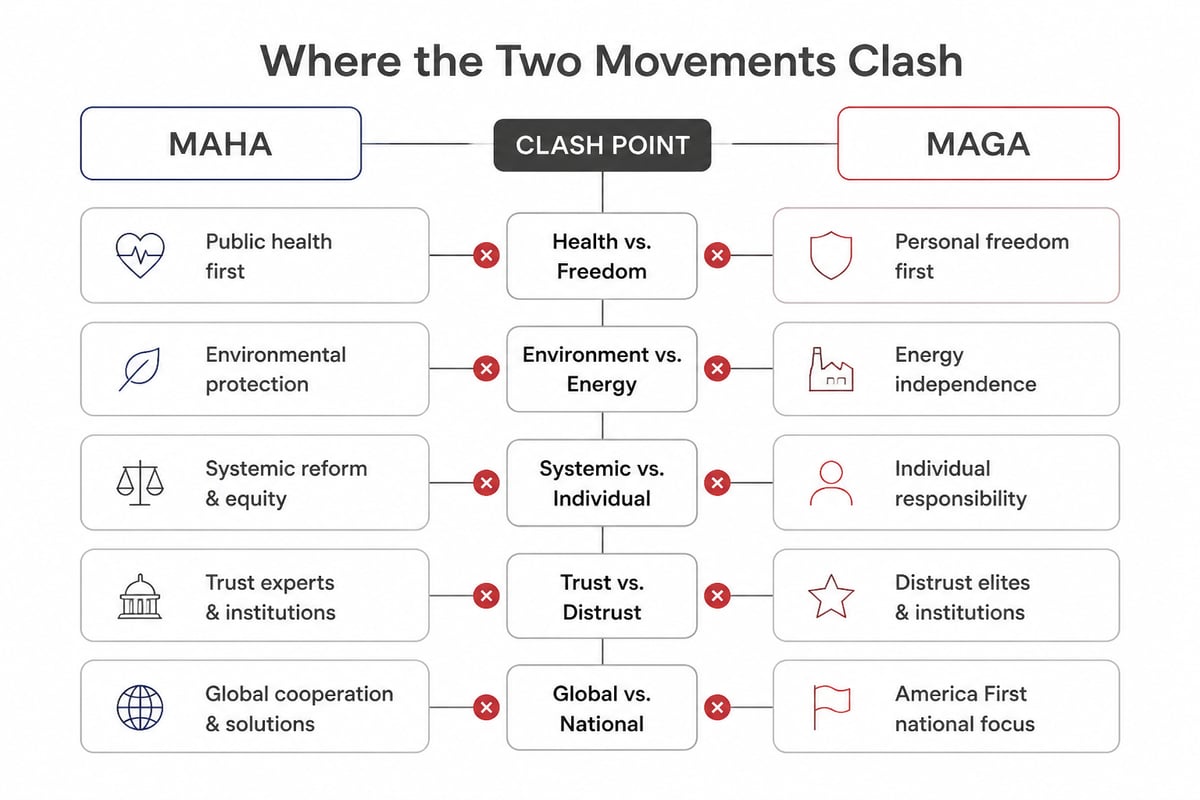
Tension between MAHA and MAGA appears mainly where health regulation collides with the pro-business, deregulatory instincts of the wider Republican coalition.
The most common friction points include:
- Food industry regulation. MAHA proposals on dyes, additives and labeling can raise costs for manufacturers, which conflicts with deregulatory priorities.
- Agriculture and chemicals. Pesticide and farm practice debates divide MAHA activists from farm-state Republicans and agricultural interests.
- Pharmaceutical policy. MAHA's skepticism toward drug companies and vaccines is not shared uniformly across Republican lawmakers.
- Federal authority. MAGA's small-government rhetoric sits awkwardly beside MAHA's call for stronger federal action on food and health.
These disagreements rarely amount to open conflict, because both movements share a common political patron and a common set of opponents. Still, the maha vs maga differences explained here show up in committee hearings, appropriations fights and agency rulemaking, where specific language matters more than slogans.
How the Executive Branch Shapes Both
Both movements depend on presidential authority, but they use different parts of it, which is why executive orders and agency control matter to each.
MAGA priorities such as immigration enforcement, tariffs and emergency declarations rely heavily on executive orders and on the boundaries of presidential emergency powers. MAHA priorities work mainly through regulatory agencies. Changes to food labeling, school meal standards and dietary guidance move through HHS, FDA and USDA rulemaking, which is slower, more technical and more exposed to legal challenge.
The MAHA Commission itself shows both sides of this arrangement. It was created by executive order on February 13, 2025, which is the fast, presidential tool. Its September 9, 2025 strategy, however, lists more than 120 initiatives that must be carried out agency by agency. Items such as revising dietary guidelines or setting infant formula standards each require their own process, with technical review and, often, public comment. A single order started the effort, but dozens of separate regulatory steps decide whether it succeeds.
That difference affects durability. An executive order can be issued quickly and reversed just as quickly by a future president. Agency rules, once finalized, require a formal process to undo. If MAHA's agenda is to outlast the current administration, it likely needs to be written into regulation or statute rather than left as a commission recommendation. Personnel matters here too: because the HHS Secretary chairs the commission, the movement's momentum depends on the same official keeping control of the agencies that write the rules.
Public Opinion and the 2026 Political Picture
The two movements face different political tests in 2026, with MAGA measured by electoral strength and MAHA by whether its proposals become policy.
MAGA's standing is tied closely to the president's own popularity, which readers can follow in coverage of Trump's approval rating in 2026. MAHA's standing is more issue-driven. Concerns about food additives and childhood health tend to poll well across party lines in the abstract, but support often weakens when proposals carry price or choice tradeoffs.
That gap between abstract and applied support is worth understanding in practical terms. A voter may agree that children should eat fewer ultra-processed foods, yet hesitate when a specific proposal would change what a school cafeteria serves or what a family pays at the grocery store. MAGA faces a similar pattern on trade, where the principle of protecting domestic industry can poll better than the price effects of a particular tariff. In both cases, the headline goal and the specific policy are judged separately by the public.
The midterms add a second layer. MAGA's strength shows up in primaries, where endorsements and base loyalty carry weight. MAHA's strength is harder to track, because its supporters are spread across parties and may not vote on health issues alone. Candidates in competitive districts will have to decide whether to embrace the MAHA label, which could attract independents and parents, or keep it at a distance to avoid friction with agricultural and food-industry interests.
Three questions will shape how both movements are judged by the end of 2026:
- Will the commission's 120-plus initiatives produce enforceable rules or remain recommendations?
- Will MAHA-aligned voters turn out in the midterms at the same rate as MAGA-aligned voters?
- Will industry pushback force the administration to choose between health regulation and deregulation?
Common Misconceptions
Several mistaken assumptions about the two labels persist, and clearing them up helps readers follow political coverage more accurately.
"MAHA is just MAGA with a new name." The two share leadership and branding, but their agendas, agencies and constituencies differ. MAHA is a policy campaign. MAGA is an entire political identity.
"MAHA is only about vaccines." Vaccine policy draws the most attention, yet the commission's documented focus spans diet, food chemicals, physical inactivity, environmental exposures and school meals.
"Every MAGA voter supports MAHA." Support is common but not universal, particularly where health rules would affect agriculture or food businesses.
"MAHA voters are all Republicans." Some are independents or former Democrats who joined the movement on food and health grounds rather than party loyalty.
Keeping these distinctions in mind makes it easier to read coverage of Congress, the courts and federal agencies without mistaking one movement's position for the other's.
Your next step is to pick one MAHA-related rule or hearing on the federal calendar this month and read the primary document before reading commentary about it. For clear, non-partisan reporting on how presidential priorities become policy, U.S. Presidential Report covers each development as it happens, and if you want to turn that interest into local engagement, you can Start Your Own Political Club and discuss these issues with neighbors who follow the same news.