Left-leaning and right-leaning views on economic policy differ mainly on how large a role government should play: the left generally favors more public spending, progressive taxes, and market regulation to reduce inequality, while the right generally favors lower taxes, lighter regulation, and market-driven growth. Those starting points shape nearly every fiscal and regulatory debate in Washington, from tax bills to trade rules to the federal budget.
This article breaks down where each side stands on taxes, spending, regulation, labor, and trade, then looks at what the economic data does and does not say about which approach performs better. It also explains why the real-world record is harder to read than either side's talking points suggest.
What Is the Difference Between Left-Wing and Right-Wing Economics?
Left-wing economics emphasizes reducing inequality and expanding economic security through government action, while right-wing economics emphasizes individual choice, private enterprise, and limited government intervention. Both camps want growth and rising living standards. They disagree about the best mechanism for getting there and about who should bear the costs.
The core split can be summarized in a few contrasts:
- Role of government: The left sees government as a tool to correct market failures and provide a safety net. The right sees it as a potential obstacle to efficient markets and personal initiative.
- Equality vs. opportunity: The left prioritizes narrowing outcome gaps. The right prioritizes equal opportunity and rewards for effort and risk-taking.
- Public vs. private provision: The left is more comfortable with public options in health care, education, and housing. The right prefers private competition and consumer choice.
- Fiscal priorities: The left tends to accept higher taxes for expanded services. The right tends to favor tax relief and spending restraint.
In American politics, these tendencies map loosely onto the Democratic and Republican parties, though neither party is uniform. Populist currents on both sides have complicated the picture, particularly on trade and industrial policy. For a party-by-party look at current platforms, see U.S. Presidential Report's breakdown of Democrat vs Republican economic policies.
How Each Side Approaches Taxes
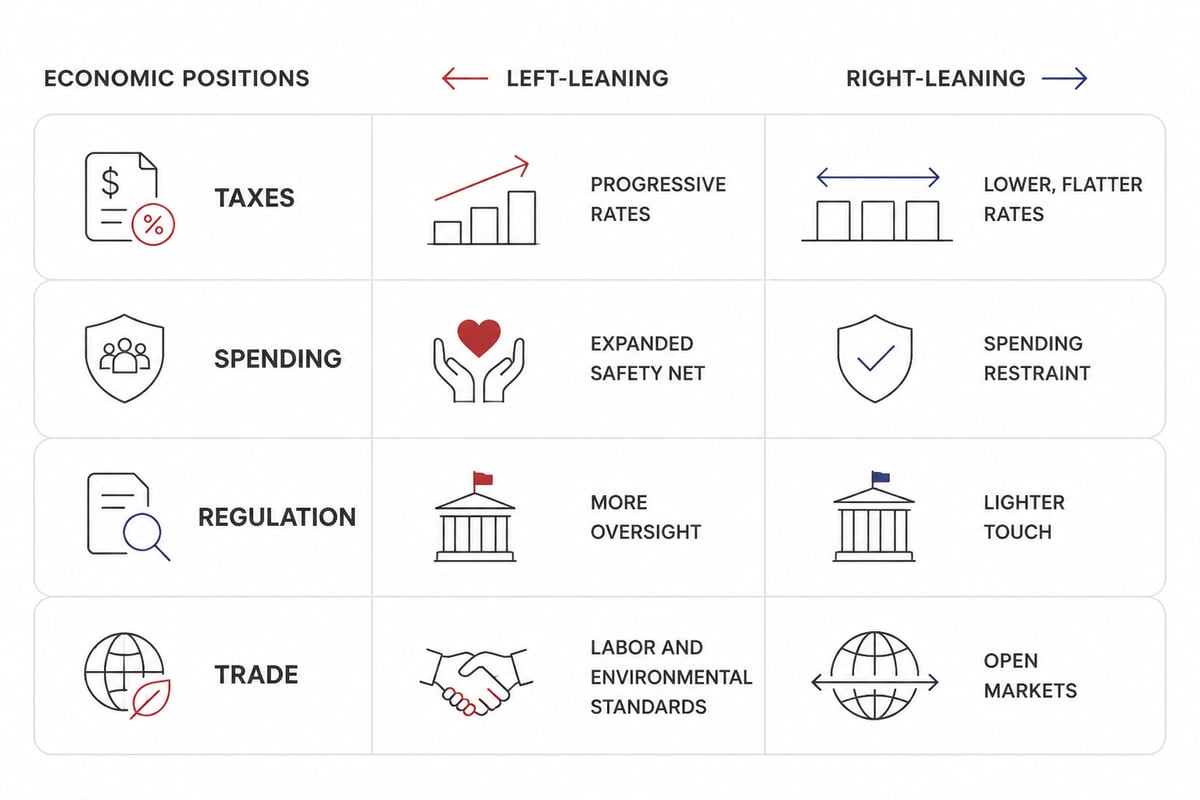
The left supports progressive taxation, where higher earners pay a larger share of income, while the right supports lower and flatter rates intended to encourage investment and work. This is the most visible dividing line in left-leaning vs right-leaning views on economic policy.
Left-leaning arguments typically stress that:
- High earners and large corporations can afford to contribute more toward public goods.
- Taxing capital gains and wealth more heavily reduces concentrated advantage.
- Revenue funds programs such as health coverage, child care, and infrastructure.
The OECD has examined this territory directly. Its July 2024 report on taxation and inequality looks at how tax systems can either reduce or worsen income and wealth inequality, including the compliance challenges posed by high-net-worth individuals. That finding supports a point both sides can accept: design and enforcement matter as much as headline rates.
Right-leaning arguments typically stress that:
- Lower marginal rates raise the reward for working, saving, and investing.
- Businesses facing lower tax burdens expand, hire, and compete globally.
- Taxpayers, not the government, generally spend money more efficiently.
Federal revenue projections show why the debate stays heated. The Congressional Budget Office projected in January 2025 that federal revenues would rise from 17.1% of GDP in 2025 to 18.2% in 2027, partly because provisions of the 2017 tax act were scheduled to expire. Whether to extend, modify, or let such provisions lapse is a central partisan fight. Readers who want the sources of federal revenue laid out can consult the CBO’s overview of federal taxes, and U.S. Presidential Report tracks the policy side in its economy and tax policy coverage.
Government Spending and the Safety Net
Left-leaning policymakers generally want to expand federal spending on health care, income support, education, and housing, while right-leaning policymakers generally want to limit spending growth and shift responsibility to states, markets, and families. The disagreement is as much about what spending accomplishes as about how much of it there should be.
The left argues that a robust safety net stabilizes the economy during downturns, reduces poverty, and invests in human capital. Programs like unemployment insurance, nutrition assistance, and Medicaid function as automatic stabilizers: they expand when the economy weakens and cushion demand.
The right counters that expansive programs can discourage work, grow the deficit, and crowd out private activity. Many conservatives favor work requirements, block grants, and market-based reforms to entitlement programs. They also stress long-term sustainability.
The numbers give both arguments something to use. The CBO's January 2025 outlook projected a fiscal year 2025 federal deficit of $1.9 trillion, or 6.2% of GDP, with outlays of $7.0 trillion against revenues of $5.2 trillion. Deficit hawks on the right point to the gap as evidence that spending is too high. The left often responds that the gap reflects insufficient revenue, particularly after tax cuts, rather than excessive public investment.
Health care illustrates the divide clearly. Democrats lean toward expanding public coverage and subsidies, and Republicans lean toward competition, deregulation, and consumer-directed plans. U.S. Presidential Report covers the current state of that debate in its health care policy coverage.
Regulation, Labor, and Business
Left-leaning views favor stronger regulation to protect workers, consumers, and the environment, while right-leaning views favor deregulation to reduce compliance costs and speed business formation. Each side treats the other's preferred approach as a risk.
Typical left-leaning positions include:
- Higher minimum wages and stronger protections for union organizing.
- Tighter environmental standards and climate-related incentives.
- Financial regulation to limit systemic risk and consumer abuse.
- Antitrust enforcement against concentrated market power.
Typical right-leaning positions include:
- Fewer federal rules on small businesses and energy production.
- Right-to-work laws and flexibility in labor markets.
- Lighter financial oversight, with emphasis on market discipline.
- Skepticism toward federal agencies' rulemaking authority.
Climate policy is a useful test case. Democrats frame clean energy investment as both an environmental and an economic strategy, creating jobs and lowering long-term costs. Republicans often argue that mandates and subsidies raise energy prices and distort markets. For a closer look, read U.S. Presidential Report's analysis of Democrat climate policies and their economic impact.
Economists across the spectrum acknowledge a real tradeoff: regulation can produce public benefits while imposing costs, and the right balance depends on the specific rule rather than on ideology alone.
Trade, Industrial Policy, and Where the Old Lines Have Blurred
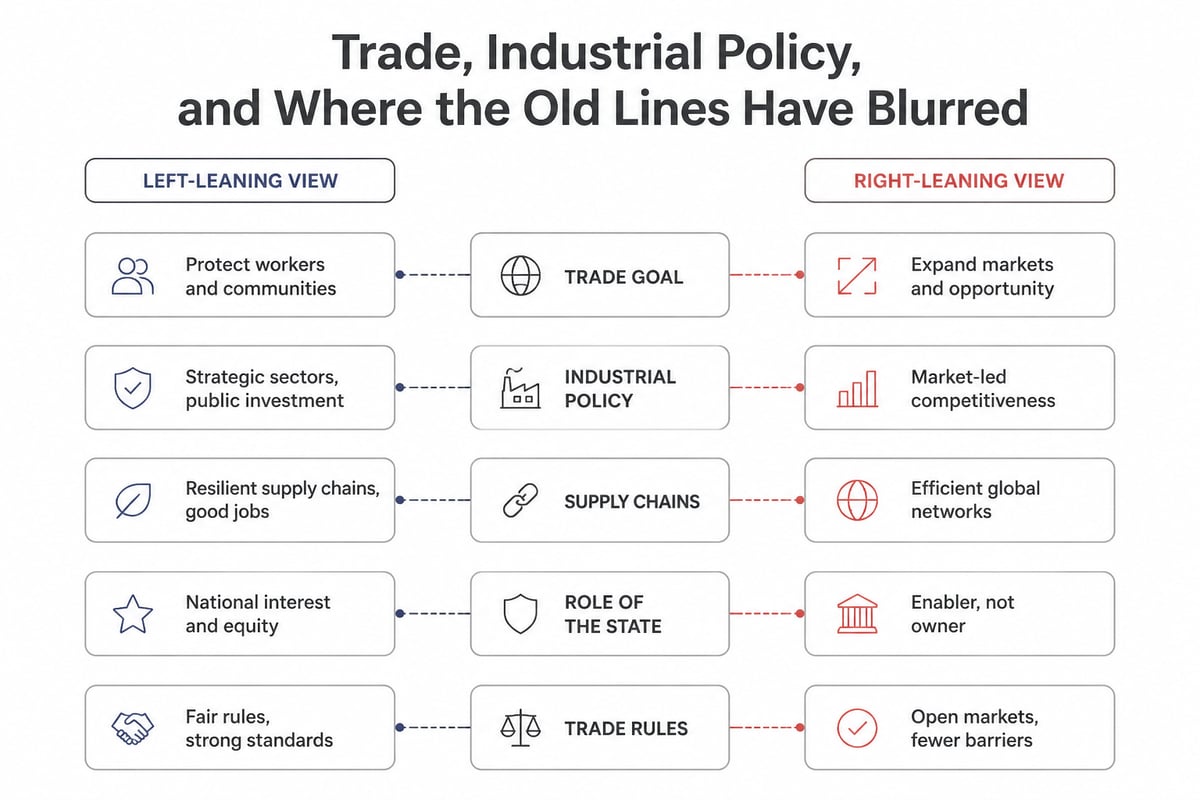
The traditional left-right split on trade has become less predictable, because both parties now include members who favor tariffs, domestic manufacturing incentives, and skepticism of globalization. Historically, the right championed free trade and the left raised labor and environmental concerns about it. Today the alignment is mixed.
Several developments illustrate the shift:
- Republican administrations have used tariffs as a central economic tool, framed as protecting American workers and industries.
- Democratic administrations have pursued large industrial subsidies for semiconductors, clean energy, and infrastructure.
- Both parties have grown more wary of dependence on foreign supply chains, particularly for strategic goods.
This realignment matters for anyone reading economic news, because a policy label no longer predicts a position reliably. A tariff may be described as conservative economic nationalism or as a tax on consumers, depending on who is speaking. U.S. Presidential Report's explainer on America First economic policy walks through that framework, and its look at Republican economic policies for 2026 covers where the party's agenda stands now.
Is the Economy Better Under Republicans or Democrats?
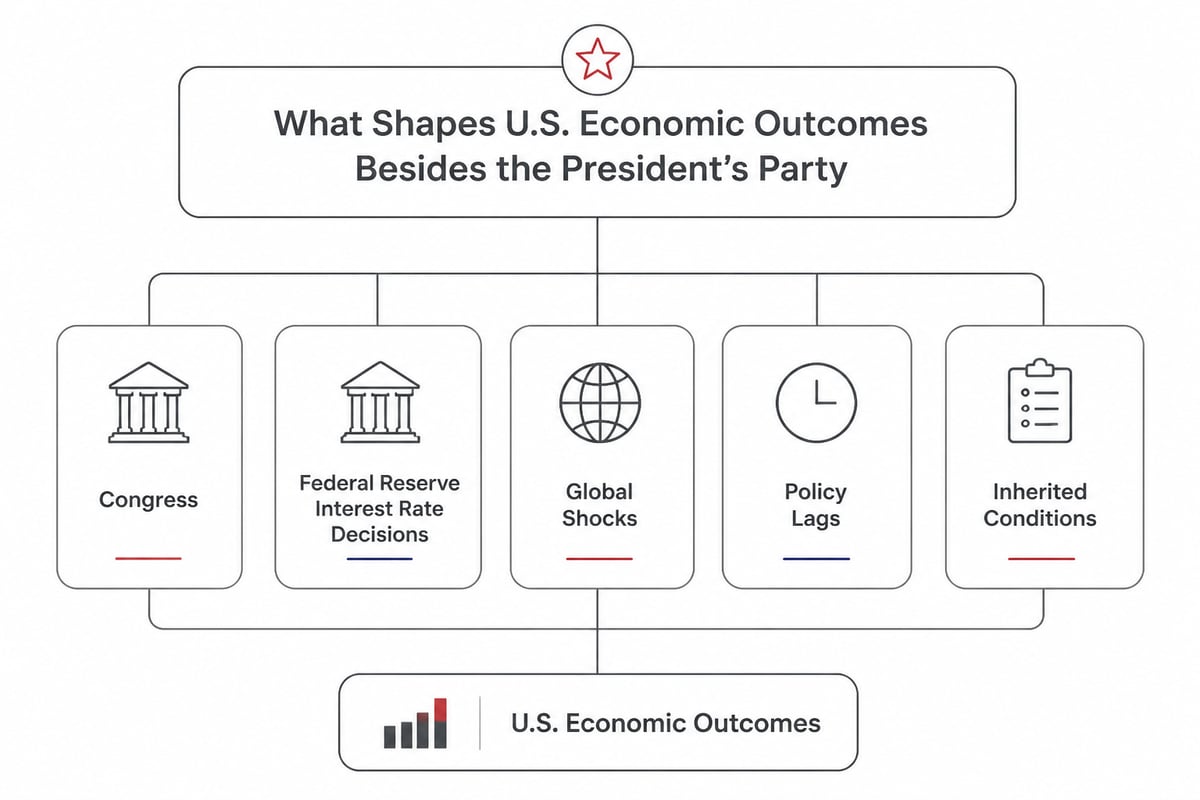
No single answer holds up, because presidents influence the economy less directly than campaign rhetoric implies, and outcomes depend heavily on Congress, the Federal Reserve, global conditions, and inherited circumstances. Comparisons that credit or blame one party for a full term's growth, jobs, or inflation oversimplify how the economy works.
Several factors complicate any party-versus-party scorecard:
- Lags: Policies often take years to affect output, so results may appear under a successor.
- External shocks: Pandemics, wars, financial crises, and energy price swings can overwhelm policy effects.
- Monetary independence: The Federal Reserve sets interest rates separately from the White House. In its June 2025 report, the Fed noted the PCE price index rose 2.1% over the 12 months ending in April 2025, with core PCE up 2.5%, outcomes shaped by monetary policy as well as fiscal choices.
- Divided government: When the parties split control of Congress and the presidency, neither can fully enact its agenda.
Voters still weigh these records, and polling on economic approval shifts with prices, wages, and employment. U.S. Presidential Report follows that sentiment in its coverage of Trump's economic approval rating and the debate over Trump economic policies and inflation. The sober reading is that economic performance is a joint product of policy, institutions, and luck.
Do Economists Tend to Lean Left or Right?
Economists as a group are often described as leaning moderately left on social issues and mixed on economic ones, but the profession is divided, and views vary widely by subfield and school of thought. Surveys of academic economists have often found somewhat more Democratic affiliation, while economists in finance, business, and some think tanks skew more Republican.
Even so, the profession shows notable agreement on narrow questions. Many economists across the spectrum accept that:
- Tariffs generally raise costs for domestic consumers and producers.
- Price controls can create shortages.
- Well-designed carbon pricing is an efficient way to cut emissions.
- Cash transfers and tax credits can reduce poverty with limited disruption.
The disagreements tend to center on magnitude and tradeoffs, such as how much a minimum wage increase affects employment, or how strongly tax rates affect work and investment. Ideology influences which tradeoffs people emphasize, which is why two credentialed economists can examine the same data and recommend different policies.
How to Evaluate Economic Claims From Either Side
The most reliable way to evaluate partisan economic claims is to check the source of the data, the time frame used, and whether the argument isolates policy from other causes. Whether the claim comes from the left or the right, a few habits improve the signal.
- Check the baseline. Growth or job gains can look strong or weak depending on the starting point, especially after a recession.
- Separate nominal from real. Wages, deficits, and spending look different once adjusted for inflation or measured as a share of GDP.
- Look for nonpartisan scorekeepers. The CBO, the Federal Reserve, and the OECD publish projections and analysis that both parties cite and contest.
- Ask what else changed. Interest rates, global prices, and congressional control often matter as much as the policy under discussion.
- Note the tradeoff. Every policy has costs and beneficiaries. A claim that mentions only benefits or only costs is incomplete.
For readers following the policy fights as they unfold, U.S. Presidential Report's economic impact news section tracks how new proposals and data releases play out against these competing frameworks.
FAQ
What is the difference between left-leaning and right-leaning?
Left-leaning refers to a general preference for government action to promote equality, expand public services, and regulate markets, while right-leaning refers to a general preference for individual liberty, free markets, and limited government. The labels describe tendencies, not fixed positions, and many Americans hold a mix of views across different issues.
Can a policy be both left-leaning and right-leaning?
Yes, some policies draw support from both sides for different reasons. The earned income tax credit, for example, has backing on the left as an anti-poverty tool and on the right as a work-based incentive. Industrial subsidies and certain tariffs have likewise attracted support across party lines in recent years.
Why do left-leaning and right-leaning economists reach different conclusions from the same data?
Economists weigh tradeoffs differently, rely on different models, and sometimes disagree about how to interpret ambiguous evidence. Questions such as how strongly taxes affect work or how much regulation costs businesses lack a single settled answer, so values and assumptions influence the conclusions.
Pick one economic issue you care about, such as taxes, inflation, or trade, and read how both parties' proposals are described before deciding which tradeoffs you find persuasive. U.S. Presidential Report publishes non-partisan coverage of presidential policy, Congress, and the courts, so you can follow these debates with context rather than spin. If you want to discuss them with others in person, Start Your Own Political Club and bring informed, civil conversation about economic policy to your community.