The American political landscape has witnessed a dramatic shift as Republicans intensify efforts to court the nation's youngest voting bloc. Understanding how Republicans are targeting Gen Z has become essential for anyone following contemporary electoral strategy. Born between 1997 and 2012, Generation Z represents roughly 68 million Americans, with the oldest members now approaching 30 years old. This cohort's political preferences will shape elections for decades, making them a strategic priority for both major parties as the 2028 presidential race approaches.
The Digital Battlefield: Where Gen Z Lives Online
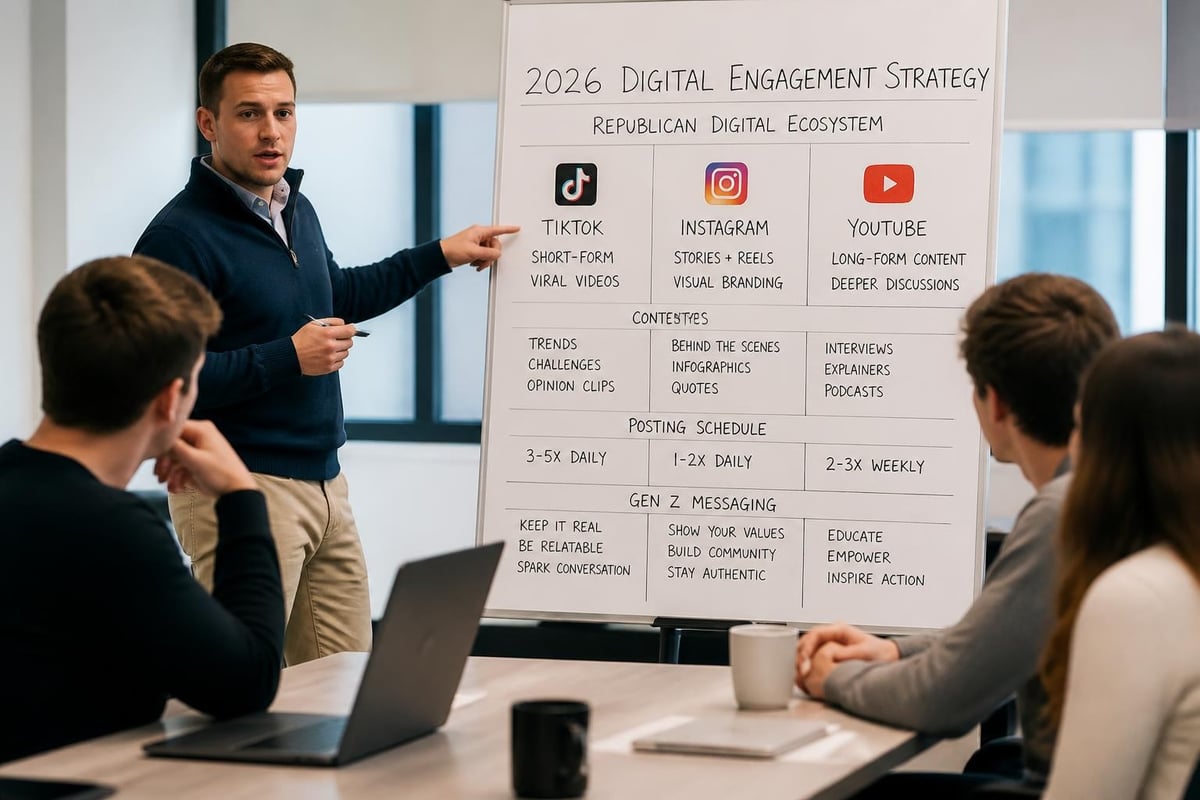
Republicans have fundamentally restructured their digital outreach, recognizing that traditional media channels hold little sway over voters who've grown up with smartphones in hand. The party's 2024-2026 strategy focuses heavily on platforms where Gen Z spends the most time: TikTok, Instagram, YouTube Shorts, and emerging platforms like Threads.
Platform-Specific Messaging Strategies
How Republicans are targeting Gen Z becomes clearest when examining their platform-specific content strategies. On TikTok alone, Republican-aligned political action committees and candidates have invested over $180 million in the 2025-2026 cycle, creating content that mirrors the authentic, unpolished aesthetic Gen Z prefers.
Research reveals significant algorithmic advantages in how political content reaches young users. A 2026 Nature study analyzing TikTok recommendations found measurable partisan skews in content delivery during the 2024 election cycle, raising questions about how organic versus amplified reach shapes political exposure. Republicans have learned to exploit these platform dynamics by:
- Creating 15-60 second videos that deliver policy positions without traditional political framing
- Partnering with micro-influencers who have 10,000-100,000 followers rather than celebrity endorsers
- Using trending audio clips and meme formats to make conservative positions feel culturally current
- Deploying rapid-response teams that can produce reaction content within hours of breaking news
The sophistication extends beyond mere presence. Republican strategists now employ A/B testing on creative approaches, tracking which messaging frames generate the highest engagement among 18-29 year-olds. Early data from 2026 campaigns shows that economic messaging outperforms cultural messaging by roughly 40% in share rates among Gen Z users.
Economic Anxiety: The Gateway Issue
While social media provides the delivery mechanism, economic concerns supply the substantive foundation for how Republicans are targeting Gen Z. This generation entered the workforce during unprecedented economic turbulence: the COVID-19 pandemic, historic inflation, a challenging housing market, and mounting student debt concerns.
Financial Messaging That Resonates
Brookings Institution research on youth voting patterns revealed that economic issues ranked as the top concern for 67% of voters aged 18-29 in 2024. Republicans have crafted messaging specifically calibrated to these anxieties:
| Economic Issue | Republican Message Frame | Target Emotion |
|---|---|---|
| Housing Affordability | "Government regulation drives up costs" | Frustration with barriers |
| Student Debt | "Career-focused alternatives to traditional college" | Aspiration and practicality |
| Inflation | "Your paycheck doesn't go as far under current policies" | Personal financial stress |
| Entrepreneurship | "Reduce barriers to starting your own business" | Ambition and independence |
The party has largely abandoned traditional supply-side economic rhetoric in favor of populist economic nationalism when addressing Gen Z. Messages emphasize "keeping jobs in America," "bringing down everyday costs," and "making housing affordable for first-time buyers." This represents a significant departure from Republican economic messaging aimed at older cohorts.
Republicans have also deployed testimonial-based content featuring Gen Z entrepreneurs, trades workers, and small business owners. These real-person narratives provide social proof that conservative economic policies can create pathways to financial stability, a particularly potent message for a generation facing median starting salaries that, adjusted for inflation, lag behind what their parents earned.
The Crypto Connection
Cryptocurrency and blockchain technology represent another economic avenue through which Republicans are targeting Gen Z. Approximately 44% of crypto owners in the United States are under 35, and Republicans have positioned themselves as the "pro-innovation" party on digital assets. Campaign events at cryptocurrency conferences, policy proposals for clear regulatory frameworks, and social media content explaining how current regulations stifle innovation all serve to build credibility with tech-forward young voters.
Cultural Messaging and Identity Politics
Beyond economics, Republicans have developed nuanced cultural messaging strategies designed to appeal to Gen Z values and frustrations. This represents perhaps the most delicate aspect of how Republicans are targeting Gen Z, as the generation holds diverse views that don't align neatly with traditional partisan categories.
Anti-Establishment Positioning
Gen Z demonstrates higher distrust of institutions than any previous generation at the same age. Republicans have leaned into anti-establishment messaging, positioning themselves as outsiders challenging "the system" despite controlling significant institutional power. This paradox works because the messaging targets cultural institutions (media, academia, entertainment) rather than governmental ones.
The Polarization Research Lab’s analysis of culture-war dynamics shows how cultural grievance messaging can mobilize younger voters when framed around free speech, meritocracy, and anti-censorship principles. Republicans have emphasized:
- Campus free speech issues, particularly around controversial speakers
- Criticisms of "cancel culture" as limiting open dialogue
- Concerns about ideological conformity in corporate environments
- Individual rights versus collective mandates (particularly post-pandemic)
These messages intentionally avoid some traditional conservative cultural positions that poll poorly with Gen Z, such as opposition to same-sex marriage or marijuana legalization.

Authenticity Over Polish
How Republicans are targeting Gen Z differs markedly from previous youth outreach in its embrace of authenticity over production value. The party has learned that highly polished campaign ads signal "inauthentic" to a generation raised on user-generated content. Successful Republican content often features:
- Vertical video shot on smartphones
- Unscripted moments and behind-the-scenes footage
- Candidates responding directly to comments and criticism
- Humor and self-deprecation rather than gravitas
This shift has created internal party tensions, with traditional consultants clashing with digital-native strategists over message control and candidate presentation. The younger staffers typically win these battles because the engagement metrics prove their approach works.
Ground Game Meets Digital Strategy
While digital platforms dominate discussion of Republican Gen Z outreach, the party hasn't abandoned field operations. Instead, they've integrated digital and physical organizing in innovative ways.
Campus Republicans Reimagined
College Republican chapters received significant infrastructure investments starting in 2024, with national party organizations providing:
- Professional staff to support student leaders
- Event funding for speakers and activism campaigns
- Voter registration and turnout technology
- Training programs on digital organizing and content creation
- Direct pipelines to internships and political careers
These campus organizations now function as content creation hubs, generating locally relevant social media posts that feel more authentic than national party messaging. A viral TikTok from a student perspective carries more weight than the same message from a congressional campaign account.
The approach mirrors Democratic campus organizing strategies from previous decades but optimized for current platform dynamics and Gen Z communication preferences.
The Apprenticeship and Trades Pivot
Recognizing that only about 40% of Gen Z attends four-year colleges, Republicans have invested heavily in outreach to young people pursuing trades, apprenticeships, and alternative career paths. This includes:
- Partnerships with vocational training programs and trade unions (particularly in non-union or right-to-work states)
- Content highlighting earning potential in skilled trades versus college-debt scenarios
- Policy proposals for expanded apprenticeship tax credits
- Events at manufacturing facilities, construction sites, and technical colleges
This strategy addresses a real constituency gap for Republicans while advancing messaging about multiple pathways to financial success beyond traditional college education.
The Data Infrastructure Advantage
Understanding how Republicans are targeting Gen Z requires examining the sophisticated data operation underlying outreach efforts. The Republican National Committee and allied organizations have built comprehensive voter files that integrate:
Consumer data indicating lifestyle preferences, purchase behaviors, and media consumption patterns
Social media behavior through pixel tracking and platform partnerships that reveal content preferences
Voter history showing which young people have voting records and which are unregistered but eligible
Modeling that predicts persuadability and likelihood of voting based on demographic and behavioral factors
| Data Source | Information Gathered | Application |
|---|---|---|
| Voter files | Registration status, voting history | Turnout targeting |
| Consumer records | Purchases, subscriptions, interests | Message customization |
| Digital tracking | Website visits, video completion rates | Content optimization |
| Survey research | Issue priorities, candidate favorability | Strategic positioning |
This data infrastructure enables microtargeting at unprecedented granularity. A 22-year-old in Phoenix interested in cryptocurrency and fitness might receive completely different messaging than a 24-year-old in Milwaukee concerned about student loans and environmental issues, even though both are categorized as "persuadable Gen Z voters."
The personalization extends to creative execution, with thousands of ad variations tested to determine which specific images, headlines, and calls-to-action resonate with different Gen Z sub-segments.

Messengers Matter: Who Delivers the Message
How Republicans are targeting Gen Z involves careful consideration of not just what messages to send but who should send them. The party has cultivated a diverse ecosystem of messengers:
The Influencer Network
Rather than relying solely on candidates and official party voices, Republicans have built relationships with content creators across the political spectrum. Some openly identify as conservative; others position themselves as independent or "politically homeless" but share content that advances Republican narratives. These influencers receive:
- Early access to candidates and officials for interviews
- Briefings on policy positions and talking points (presented as background information rather than directives)
- Invitations to exclusive events and experiences
- Financial support through sponsorships and advertising buys
The relationship typically maintains plausible independence-creators aren't formally affiliated with campaigns or parties, preserving the authenticity that gives them credibility with Gen Z audiences.
Peer-to-Peer Advocacy
Republicans have also invested in training programs that teach young conservatives to become advocates within their social circles. These programs emphasize conversational persuasion rather than confrontational debate, equipping participants with:
- Narrative frameworks for discussing policy issues
- Techniques for finding common ground with politically diverse friends
- Resources for answering common questions and objections
- Community support through online forums and local meetups
This grassroots approach recognizes that Gen Z trusts peer recommendations more than institutional messaging, making one-on-one conversations potentially more effective than mass media campaigns.
Policy Positions Calibrated to Gen Z Priorities
While messaging and delivery mechanisms matter enormously, how Republicans are targeting Gen Z ultimately rests on whether policy positions address this generation's priorities. Republicans have moderated or evolved on several issues where traditional conservative positions conflict with Gen Z preferences:
Environmental policy: Rather than denying climate concerns, many Republican candidates now emphasize "innovation-driven solutions," nuclear energy, and criticism of China's environmental record.
Criminal justice: Republicans have adopted rhetoric around sentencing reform and alternatives to incarceration, issues that poll well with younger voters.
Healthcare: While maintaining opposition to single-payer systems, Republicans increasingly propose alternatives that address coverage gaps and cost concerns.
The party has maintained harder-line positions on issues like immigration and national security, betting that economic and cultural messaging will prove more salient to most Gen Z voters than disagreements on these fronts.
For readers interested in tracking how presidential candidates navigate these policy discussions, U.S. Presidential Report’s politics coverage offers non-partisan analysis of evolving positions across administrations.
The 2024 Foundation and 2026 Acceleration
Republican efforts to court Gen Z intensified significantly after the 2024 presidential election, which provided valuable data on what worked. Exit polls showed modest improvements in Republican performance among 18-29 year-olds compared to 2020, particularly among young men and voters without college degrees.
Building on that foundation, the 2026 midterm campaigns have accelerated investment in Gen Z outreach. Competitive Senate and House races feature candidates who themselves are millennials or elder Gen Z members, bringing generational credibility to Republican tickets. The party has also recruited Gen Z candidates for state legislative races, creating a bench of young elected officials who can serve as relatable messengers.
Analysis from the German Marshall Fund’s examination of platform strategies during 2024 revealed how candidates utilized TikTok specifically, providing a playbook that 2026 campaigns have refined further. The report highlighted how even candidates initially skeptical of the platform eventually adopted it when internal polling showed significant Gen Z voter reach.
Challenges and Contradictions
Despite sophisticated strategies, Republicans face inherent challenges in how Republicans are targeting Gen Z. Polling consistently shows this generation trending more liberal on social issues, with strong support for LGBTQ+ rights, abortion access, and racial justice initiatives that conflict with positions held by significant Republican constituencies.
The party attempts to navigate these tensions through:
- Localized messaging that varies by region and race competitiveness
- Emphasis on economic over social issues in Gen Z-targeted content
- Highlighting intra-party diversity by elevating young Republicans who hold more moderate social positions
- Attacking Democratic positions rather than affirmatively defending conservative ones on divisive cultural issues
This approach requires constant calibration and sometimes produces mixed signals. A Republican candidate might emphasize free-market economics on TikTok while their campaign sends direct mail about cultural issues to older voters in the same district.
Another challenge involves the platform environment itself. Research showing partisan skews in algorithmic recommendations during the 2024 cycle raised concerns about whether organic reach favors certain content, complicating efforts to assess genuine versus amplified engagement.
Looking Ahead to 2028
As presidential campaigns begin taking shape for 2028, how Republicans are targeting Gen Z will likely influence candidate selection and platform development. The oldest Gen Z voters will be 31 by the next presidential election, firmly established in the electorate with voting patterns beginning to solidify.
Republican strategists recognize that winning even 45% of Gen Z voters (compared to typical 35-40% performance) could prove decisive in swing states where younger voters comprise growing portions of the electorate. This math drives continued investment in digital infrastructure, messenger development, and policy evolution.
The 2028 primary will test which Republican candidates can authentically connect with younger voters. Early indications suggest that age alone won't determine success-younger candidates must still demonstrate policy fluency and cultural literacy, while older candidates can succeed by demonstrating genuine understanding of Gen Z concerns rather than pandering.
Those following these developments can track candidate announcements and policy positions through resources like the presidential candidates list, which provides comprehensive information as the 2028 field takes shape.
Republicans have deployed a multifaceted strategy to reach America's youngest voters, combining sophisticated digital operations with substantive economic messaging and carefully calibrated cultural positioning. As these efforts continue evolving through 2026 and toward 2028, understanding the tactics and motivations behind them becomes essential for anyone following American electoral politics. For comprehensive, non-partisan coverage of how presidential candidates and parties navigate these crucial demographic shifts, U.S. Presidential Report provides the analysis and context needed to make sense of America's changing political landscape.