The path to the White House runs through a narrow corridor of competitive states where every vote matters and every strategic decision can tip the balance. Understanding the republican swing state strategy requires analyzing demographic shifts, turnout patterns, and sophisticated campaign infrastructure that has evolved dramatically since 2016. As the 2028 election cycle approaches, examining how Republicans approach Pennsylvania, Georgia, Wisconsin, Arizona, Michigan, Nevada, and North Carolina reveals critical insights about modern presidential politics and the mechanics of winning 270 electoral votes.
The Foundation of Republican Swing State Strategy
Modern republican swing state strategy builds on three pillars: precise voter identification, resource allocation based on electoral math, and message tailoring to local concerns. Unlike national campaigns of previous decades, today's battleground operations function as semi-autonomous entities with localized leadership and data infrastructure.
Key components of this approach include:
- County-level turnout modeling using precinct data from previous cycles
- Demographic targeting that identifies persuadable voters versus base mobilization opportunities
- Early voting and absentee ballot programs customized to each state's election laws
- Coordinated expenditures that maximize party committee resources alongside super PAC investments
The strategic framework depends heavily on official Census Bureau voting and registration data that provides demographic breakdowns essential for targeting decisions. Republican operatives analyze these datasets to identify which communities offer the highest return on investment for door-knocking, digital advertising, and television buys.
Geographic Prioritization and the Rust Belt Focus
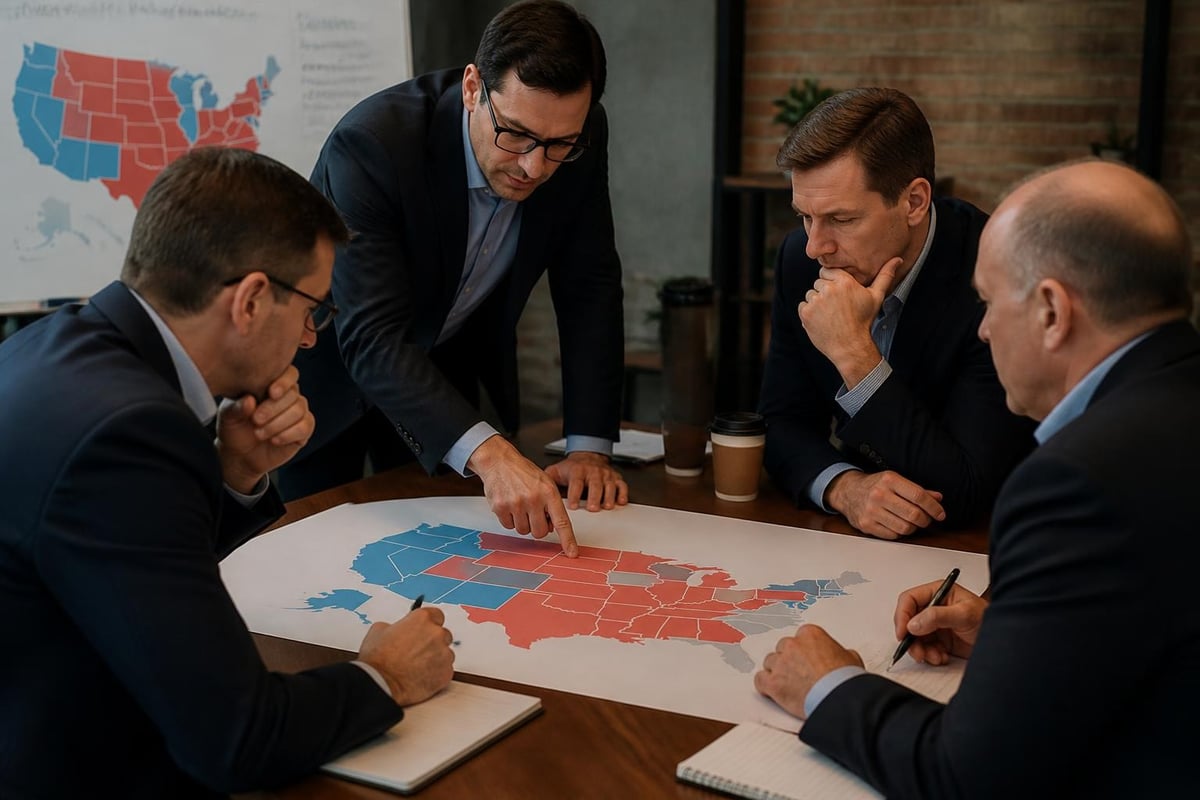
Pennsylvania, Michigan, and Wisconsin form the "blue wall" that Republicans successfully breached in 2016, demonstrating that the republican swing state strategy could crack Democratic advantages in industrial regions. These three states alone provide 44 electoral votes, making them the single most efficient path to victory when combined with traditional Republican strongholds.
The Pew Research Center’s analysis of partisan alignment across communities reveals critical trends that shape strategy in these states. Suburban voters, once reliably Republican, have become genuine swing voters, while rural turnout has emerged as a crucial counterweight to Democratic urban dominance.
| State | Electoral Votes | 2024 Margin | Key Republican Counties | Strategic Priority |
|---|---|---|---|---|
| Pennsylvania | 19 | R+1.2% | Westmoreland, Butler, Cumberland | Maximum |
| Wisconsin | 10 | R+0.8% | Waukesha, Washington, Ozaukee | Maximum |
| Michigan | 15 | R+1.5% | Macomb, Ottawa, Kent | Maximum |
| Georgia | 16 | R+2.1% | Cherokee, Forsyth, Paulding | High |
| Arizona | 11 | R+2.8% | Maricopa suburbs, Yavapai | High |
Demographic Targeting and Coalition Building
The republican swing state strategy has evolved to recognize that winning coalitions look different across battleground states. What works in Arizona's growing Sun Belt electorate differs fundamentally from Wisconsin's older, whiter demographic profile.
Suburban Realignment Strategy
Suburban counties surrounding major metropolitan areas have become the primary battleground within battlegrounds. Republican strategists focus on retaining college-educated white voters who have drifted toward Democrats while maximizing turnout among non-college whites in exurban communities.
Tactical approaches in suburban zones:
- Economic messaging emphasizing tax policy and small business concerns
- Education issues, particularly parental rights and school choice
- Public safety themes without inflammatory rhetoric
- Infrastructure and development issues relevant to growing communities
- Softer social messaging that avoids alienating moderate voters
The challenge involves balancing base enthusiasm with persuasion of middle-ground voters. Research from MIT’s Election Data & Science Lab on voter turnout shows that suburban turnout tends to be higher and more variable than rural areas, making these voters disproportionately influential in close elections.
Rural Turnout Maximization
While suburban persuasion matters, the republican swing state strategy increasingly depends on generating exceptional rural turnout to offset Democratic urban advantages. This approach treats rural counties not as guaranteed wins but as vote banks requiring active cultivation.
In Wisconsin, for example, maximizing turnout in counties like Marathon, Wood, and Portage can generate vote margins that neutralize Democratic advantages in Milwaukee and Dane counties. The U.S. Presidential Report has documented how this pattern repeated across multiple swing states in 2024, with rural overperformance proving decisive.
Data Infrastructure and Microtargeting Operations
Modern republican swing state strategy relies on sophisticated data operations that would have been unthinkable two decades ago. The 2024 Precinct Project from Electionline and MIT demonstrates the granular level at which campaigns now analyze voter behavior, examining shifts at the individual precinct level to identify emerging opportunities.
Voter File Integration and Modeling
Republican state parties and allied organizations maintain comprehensive voter files that integrate:
- Public voter registration records and turnout history
- Consumer data indicating lifestyle and purchasing patterns
- Survey responses from phone and digital polling
- Social media activity and engagement metrics
- Caucus and primary participation records
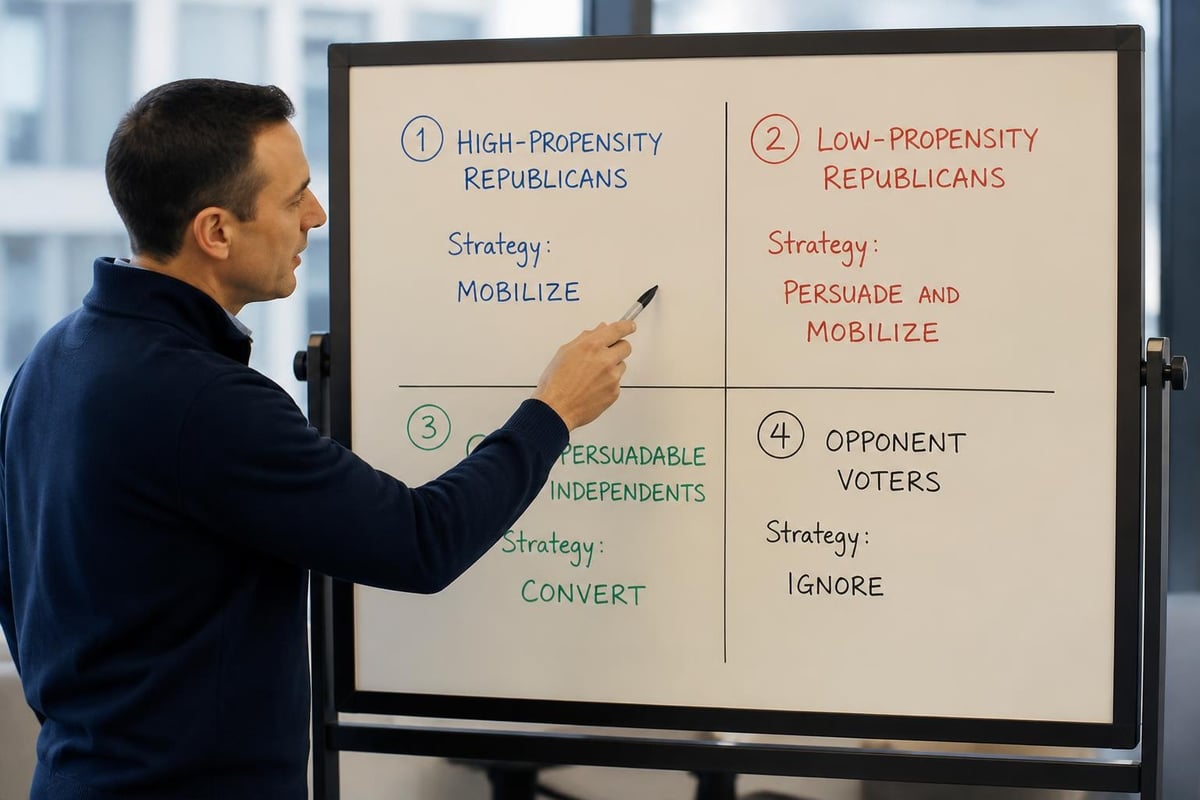
This data feeds predictive models that score each voter on multiple dimensions, including likelihood to support Republican candidates, probability of voting, and persuadability. These scores determine who receives door knocks, phone calls, digital ads, and direct mail.
The modeling process typically involves:
- Regression analysis identifying which voter attributes correlate with Republican support
- Turnout models predicting who will vote based on past behavior and demographic factors
- Persuasion scores estimating which voters might be moved by specific messages
- Issue prioritization models determining which topics resonate with specific voter segments
Digital Advertising and Geofencing
The republican swing state strategy leverages digital tools to reach voters with unprecedented precision. Campaigns use geofencing to deliver mobile ads to devices that have visited specific locations, targeting attendees of local events, visitors to particular stores, or residents of carefully selected neighborhoods.
Connected TV advertising allows Republicans to buy ads on streaming platforms that appear only to target households in swing districts within swing states. This approach eliminates waste inherent in traditional television buys that reach many viewers outside the target universe.
Ground Game and Field Operations
Despite digital sophistication, the republican swing state strategy still depends heavily on traditional field operations. Door-to-door canvassing remains the most effective persuasion and mobilization tool, particularly in communities where voters are skeptical of media messaging.
Volunteer Recruitment and Training
Republican field operations in swing states typically begin 12-18 months before Election Day, recruiting volunteers from churches, gun clubs, business organizations, and other conservative-leaning community groups. These volunteers receive training on:
- Identifying voter concerns through active listening
- Delivering persuasion messages without appearing pushy
- Collecting data about voter preferences and contact quality
- Recruiting additional volunteers from their social networks
The strategy emphasizes "relational organizing," where volunteers contact people they know personally rather than cold-calling strangers. Studies consistently show that messages from friends and neighbors prove more persuasive than contact from paid staff or unknown volunteers.
Early Vote and Absentee Ballot Programs
Republican strategies have evolved to embrace early voting and mail balloting after initially viewing these mechanisms with suspicion. The republican swing state strategy now includes robust early vote programs that bank favorable votes before Election Day, reducing the number of supporters who must be mobilized on a single day.
Different state election administration practices create varying opportunities and challenges. Pennsylvania's restricted absentee voting contrasts sharply with Arizona's permanent early voter list, requiring completely different tactical approaches despite both states being critical battlegrounds.
| State | Early Vote Period | No-Excuse Absentee | Mail Ballot Deadline | Republican Strategic Approach |
|---|---|---|---|---|
| Pennsylvania | Limited in-person | Yes (since 2020) | Election Day receipt | Aggressive absentee chase |
| Wisconsin | Two weeks in-person | Yes | Election Day receipt | Balanced early/ED push |
| Georgia | Three weeks in-person | Yes | Close of polls | Heavy early vote emphasis |
| Arizona | 27 days early | Yes (permanent list) | 7pm Election Day | Dominant early vote focus |
Message Development and Testing
The republican swing state strategy recognizes that effective messaging must resonate with local concerns while advancing broader campaign themes. What works in Michigan's manufacturing communities may fall flat in Arizona's retirement destinations.
Polling and Focus Group Research
Republican campaigns invest heavily in state-specific polling that goes beyond horse-race numbers to explore issue salience, message effectiveness, and vulnerability testing. Focus groups in swing states provide qualitative insights that surveys cannot capture, revealing how voters actually talk about issues and candidates.
Key research questions include:
- Which issues drive vote choice among persuadable voters?
- What arguments against Democratic opponents gain traction?
- Which messengers (candidates, surrogates, validators) carry credibility?
- What concerns might depress Republican turnout if unaddressed?
Media Market Optimization
Swing states contain multiple media markets with distinct characteristics. The republican swing state strategy allocates advertising budgets based on cost-efficiency and voter concentration, not just state boundaries. Pennsylvania's diverse geography means campaigns must buy ads in Philadelphia, Pittsburgh, Harrisburg-Lancaster, Wilkes-Barre, Erie, and Johnstown markets, each requiring tailored creative and varying expenditure levels.

Coalition Maintenance and Expansion
Successful republican swing state strategy requires both energizing the existing Republican coalition and expanding it to include new voters or converts. This dual mandate creates tension between base mobilization and persuasion efforts.
Minority Voter Outreach
While Republicans remain dependent on overwhelming white voter support in most swing states, the party has made targeted inroads with Black voters (particularly Black men), Hispanic voters, and Asian American communities. The strategy focuses on economic messaging, religious values, and dissatisfaction with Democratic governance in urban areas.
Research from the Brennan Center documenting racial disparities in turnout reveals opportunities where lower turnout among Democratic-leaning minority voters can shift outcomes even without persuading these voters to switch parties. Republican strategy includes both conversion attempts and efforts to reduce enthusiasm among Democratic constituencies.
Working-Class Appeal Across Racial Lines
The most significant evolution in republican swing state strategy involves cultivating a multiracial working-class coalition united by economic concerns, skepticism of elites, and social conservatism. This approach emphasizes:
- Opposition to trade deals perceived as benefiting corporations over workers
- Skepticism of immigration's impact on wages and employment
- Support for domestic energy production and manufacturing jobs
- Cultural traditionalism on family, education, and community
This messaging appears across swing states but resonates particularly strongly in Pennsylvania, Michigan, Wisconsin, and Ohio (the latter being less competitive but culturally influential in the region).
Legal and Administrative Preparedness
Modern republican swing state strategy extends beyond campaigning to include extensive legal and administrative preparation. Campaigns deploy attorneys to monitor election administration, challenge procedures they view as favoring Democrats, and prepare for potential recounts or contests.
Election Integrity Operations
Republican state parties and allied organizations recruit poll watchers, train them on state laws and procedures, and position them at polling locations in Democratic-leaning areas where they believe irregularities are most likely. These operations serve both to identify genuine problems and to demonstrate to Republican voters that the party is protecting their interests.
Legal teams prepare challenges to election rules regarding mail ballot deadlines, signature verification standards, voter ID requirements, and provisional ballot procedures. The NYU Law Review’s analysis of state constitutions and redistricting provides context for how state-level legal frameworks shape these battles.
Recount and Contest Preparation
In states where margins may fall within recount thresholds, campaigns prepare detailed plans for funding recounts, recruiting attorneys, mobilizing volunteers to observe vote counting, and communicating with supporters about the process. This preparation proved crucial in several 2020 and 2024 swing state contests where initial margins were razor-thin.
Resource Allocation and Budget Strategy
The republican swing state strategy must allocate limited resources across multiple expensive states while maintaining competitiveness in each. This creates difficult tradeoffs between spreading resources broadly versus concentrating efforts where victory seems most achievable.
The 270 Electoral Vote Calculation
Republican strategists work backward from 270 electoral votes, identifying the most efficient combinations of swing states that produce victory. If Republicans carry all states won in 2024, they need only hold their gains in Pennsylvania, Georgia, and Wisconsin (45 electoral votes) to secure another term.
Common pathway scenarios:
- Rust Belt Strategy: Pennsylvania + Wisconsin + Michigan = 44 EVs (near-certain victory when combined with safe states)
- Sun Belt Alternative: Georgia + Arizona + Nevada = 33 EVs (requires more safe state expansion)
- Diversified Approach: Pennsylvania + Georgia + Arizona = 46 EVs (geographic spread reduces single-state dependency)
- Maximum Expansion: All seven swing states = 93 EVs (overwhelming mandate but resource-intensive)
Each scenario requires different resource allocation. The diversified approach has become most common, as it provides multiple paths to victory and prevents opponents from concentrating resources in a single must-win state.
Independent Expenditure Coordination
Super PACs and outside groups play massive roles in swing state strategy, often spending as much or more than the official campaigns. While legal restrictions prevent formal coordination, Republican campaigns and outside groups use publicly available information and aligned strategists to avoid duplication and maximize efficiency.
Major Republican-aligned groups divide responsibilities, with some focusing on persuasion advertising, others on turnout operations, and still others on opposition research and attack ads. This division of labor allows the overall effort to cover more ground than any single entity could manage.
Adaptation and Real-Time Adjustments
The republican swing state strategy is not static. Campaigns continuously monitor polling, early vote data, and field reports to adjust tactics as conditions change. This adaptive approach distinguishes successful operations from those that rigidly follow predetermined plans regardless of emerging realities.
Early Vote Monitoring and Response
As early voting proceeds, campaigns analyze partisan breakdowns, demographic composition, and geographic patterns. If Republican early vote numbers fall short of targets, campaigns shift resources toward mobilization. If numbers exceed expectations, resources can move to persuasion or be redirected to other states.
Modern data infrastructure allows near-real-time tracking of who has voted. When a targeted Republican voter casts a ballot early, they are removed from mobilization lists and resources redirect to voters who have not yet participated. This continuous optimization ensures maximal efficiency.
Debate Performance and October Surprises
Presidential and vice-presidential debates often occur during early voting, creating opportunities to capitalize on strong performances or necessities to recover from weak showings. The republican swing state strategy includes rapid response capabilities that can shift messaging within hours of major news events.
October surprises-unexpected revelations, endorsements, or events-require flexible resource reserves. Campaigns typically hold back 10-15% of budgets for deployment in the final weeks when unanticipated developments demand response.
State-Specific Strategic Variations
While overarching principles guide the republican swing state strategy, each battleground requires unique approaches based on its political culture, demographic composition, and electoral history.
Pennsylvania: The Keystone Battleground
With 19 electoral votes, Pennsylvania receives disproportionate attention. The state's diversity-from Philadelphia suburbs to Pittsburgh's industrial communities to rural Appalachian regions-demands varied messaging and coalition-building.
Republican strategy focuses on:
- Maximizing margins in "T" counties (the rural and small-town regions forming a T-shape across the state)
- Winning suburban counties like Chester, Bucks, and Montgomery by narrower margins than Democrats win Philadelphia
- Energizing southwestern Pennsylvania around economic nationalism and energy sector jobs
- Suppressing third-party votes in Philadelphia that might otherwise go Democratic
Georgia: The New South Swing State
Georgia's evolution from Republican stronghold to competitive battleground has forced strategic adaptation. The republican swing state strategy here balances suburban retention around Atlanta with overwhelming rural performance.
Critical elements include:
- Holding margins in fast-growing suburban counties (Forsyth, Cherokee, Paulding)
- Maximizing turnout in South Georgia's rural communities
- Competing for conservative-leaning minority voters, particularly in metro Atlanta
- Managing the influence of Atlanta's progressive activism through voter suppression allegations
Wisconsin: Margin Management in Dairyland
Wisconsin's relatively small population means that modest shifts in a few counties can determine outcomes. Republican strategy emphasizes:
- Generating exceptional turnout in the WOW counties (Waukesha, Ozaukee, Washington)
- Winning working-class voters in counties that swung from Obama to Trump
- Managing margins in Dane County (Madison) through third-party candidates and turnout depression
- Targeting Door County and other "bellwether" jurisdictions that reflect statewide sentiment
Coverage at U.S. Presidential Report on recent election developments provides ongoing analysis of how these state-specific strategies evolve as political conditions change.
Future Challenges and Strategic Evolution
The republican swing state strategy must adapt to changing demographics, evolving media consumption habits, and shifting political coalitions. States that are competitive today may become safe for either party by 2032, while new battlegrounds may emerge.
Demographic Headwinds in Sun Belt States
Arizona, Georgia, and Nevada all face demographic trends that favor Democrats over time: growing Hispanic populations, influxes of college-educated professionals, and increasing urbanization. Republican strategy must either accelerate current minority outreach or find new Sun Belt states to compensate.
Media Fragmentation and Message Delivery
The continuing collapse of traditional media creates challenges for message delivery. As fewer voters watch cable news or read newspapers, campaigns must reach audiences through increasingly fragmented digital channels. The republican swing state strategy will need to master emerging platforms while maintaining presence on established ones.
Generational Replacement and Coalition Stability
The Republican coalition's dependence on older white voters creates long-term sustainability questions. As generational replacement continues, the republican swing state strategy must either adapt messaging to appeal to younger voters or find efficiency gains among existing supporters that compensate for declining numbers.
The republican swing state strategy represents a sophisticated, data-driven approach to winning presidential elections in an era of narrow margins and geographic polarization. Understanding these tactics provides essential context for analyzing election outcomes and anticipating future campaign developments. For comprehensive, non-partisan coverage of presidential politics, election strategy, and the latest developments shaping American governance, explore the resources available at U.S. Presidential Report, where readers find balanced analysis of the political landscape affecting current and future presidencies.