The relationship between Americans and their news media has reached a critical breaking point. Trust in journalism has plummeted to historic lows, with profound implications for democratic governance and public understanding of presidential actions and policies. Understanding why americans distrust the media requires examining multiple interconnected factors, from perceived partisan bias to the proliferation of misinformation and the changing economics of news production. For those seeking reliable presidential news and analysis, recognizing these trust challenges becomes essential to navigating today's fragmented information landscape.
The Historical Decline of Media Credibility
The erosion of trust didn't happen overnight. Americans’ confidence in the media remains near record lows, with polling data revealing a steady decline over the past two decades. In the 1970s, major news networks and newspapers commanded widespread public confidence, serving as primary gatekeepers of information about presidential administrations and national affairs.
Several turning points accelerated this decline. The rise of 24-hour cable news in the 1990s introduced a competitive pressure that prioritized speed over verification. The Iraq War coverage in the early 2000s, where major outlets uncritically reported unverified claims about weapons of mass destruction, damaged credibility significantly. More recently, coverage inconsistencies during presidential elections and policy debates have deepened skepticism.
Generational Shifts in News Consumption
Younger Americans exhibit particularly pronounced distrust. Research shows American teenagers describe journalism with terms like "biased," "fake," and "boring," reflecting fundamental disconnection from traditional news formats. This generational divide suggests the trust crisis will intensify unless news organizations adapt their approaches to covering presidential administrations and political developments.

Partisan Polarization and Perceived Bias
Perhaps no factor explains why americans distrust the media more powerfully than perceived political bias. News consumption has become increasingly segregated along partisan lines, with conservatives and liberals inhabiting separate information ecosystems. This polarization particularly affects coverage of presidential actions, where identical events receive dramatically different framing depending on the outlet.
Key manifestations of partisan bias concerns include:
- Selective story emphasis based on political implications
- Disparate treatment of presidential administrations from different parties
- Commentary presented as objective reporting
- Source selection that reinforces predetermined narratives
The partisan divide creates a self-reinforcing cycle. When audiences primarily consume news aligned with their political preferences, they become more sensitive to perceived bias in alternative sources. This dynamic has intensified during recent presidential administrations, where coverage choices about executive powers and policy decisions often reflect ideological frameworks rather than neutral analysis.
The Impact of Presidential Rhetoric
Political leaders themselves have contributed significantly to media distrust. The “Fake News” rhetoric has contributed substantially to declining confidence in journalism. When presidents and other officials regularly attack news coverage as dishonest or fabricated, they provide their supporters with ready-made justifications for dismissing unfavorable reporting.
This dynamic creates particular challenges for presidential news coverage. Audiences struggle to distinguish between legitimate criticism of journalistic errors and politically motivated attacks designed to discredit accountability reporting. The result is widespread confusion about which sources merit trust when evaluating presidential statements and actions.
Misinformation and Accuracy Concerns
The digital age has fundamentally altered how information spreads, making it increasingly difficult for audiences to distinguish credible reporting from fabrication. Understanding why americans distrust the media requires acknowledging that some skepticism stems from legitimate concerns about accuracy and fact-checking failures.
| Type of Error | Impact on Trust | Example Context |
|---|---|---|
| Factual mistakes | High – undermines basic credibility | Incorrect vote counts during elections |
| Misleading headlines | Medium – creates perception of manipulation | Sensationalized presidential policy coverage |
| Uncorrected errors | Very High – suggests institutional dishonesty | Retracted stories without prominent corrections |
| Anonymous sourcing abuse | Medium – raises verification questions | Unverifiable claims about White House dynamics |
News organizations have struggled with the speed-versus-accuracy trade-off in the digital era. The pressure to publish breaking news about presidential actions quickly has led to high-profile corrections and retractions. The importance of accuracy and correcting mistakes cannot be overstated when attempting to restore public confidence.
The Social Media Amplification Effect
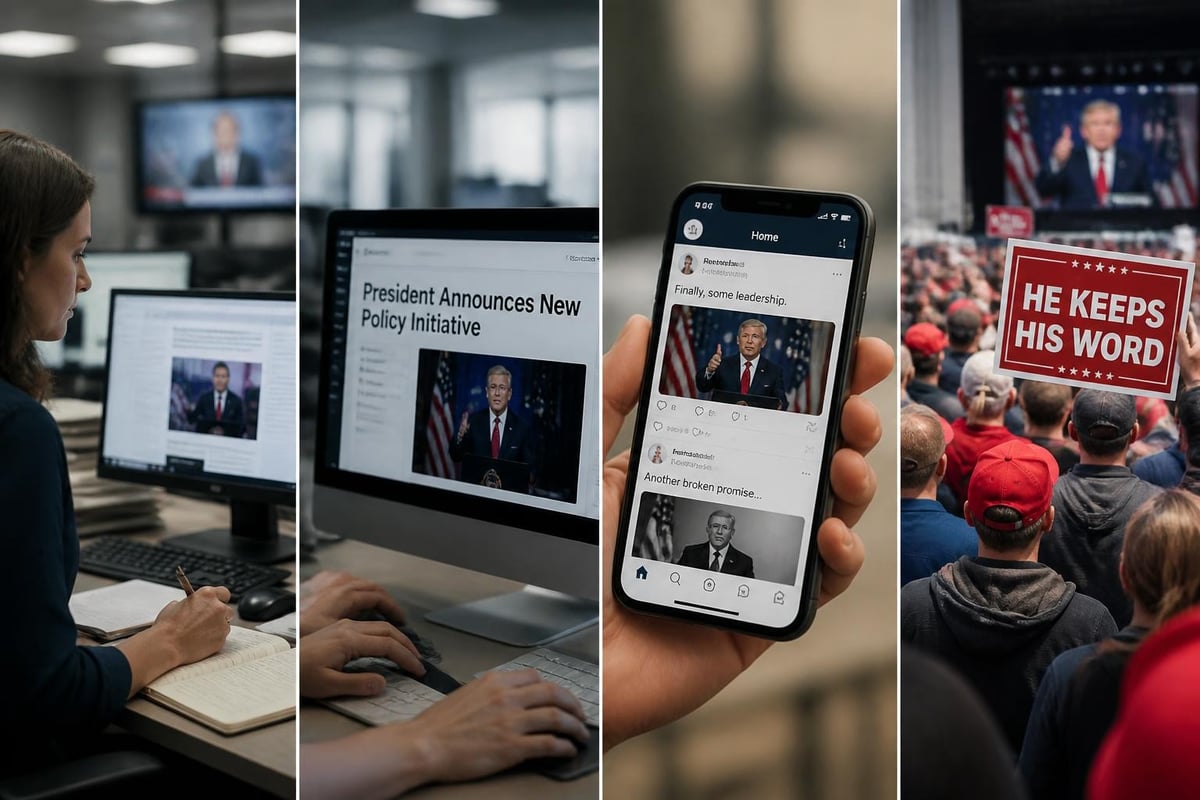
Social media platforms have amplified both misinformation and distrust. False claims about presidential policies spread rapidly, often reaching larger audiences than subsequent corrections. Meanwhile, legitimate news coverage gets fragmented and decontextualized as it circulates through social networks, making it difficult for audiences to assess credibility.
Traditional media can learn from independent creators who build trust through transparency and direct audience engagement. This approach contrasts with the institutional opacity that characterizes many traditional newsrooms covering presidential administrations.
Economic Pressures and Business Model Challenges
The financial crisis facing journalism directly impacts why americans distrust the media. As advertising revenue has migrated to digital platforms, news organizations face intense pressure to attract clicks and engagement. This economic reality influences editorial decisions about presidential coverage in ways that undermine credibility.
Economic factors affecting coverage quality:
- Reduced reporting resources – Fewer journalists covering more ground means less investigative depth
- Clickbait incentives – Headlines designed for engagement rather than accuracy
- Entertainment orientation – Presidential news presented as drama rather than policy analysis
- Cost-cutting in fact-checking – Reduced investment in verification processes
- Consolidation effects – Fewer independent newsrooms providing diverse perspectives
These pressures have particularly affected coverage of complex policy issues. When newsrooms lack resources for deep investigation into presidential initiatives regarding domestic policy or foreign affairs, coverage becomes superficial and easily dismissed as uninformed.
The Subscription Model Challenge
While some premium outlets have successfully transitioned to reader-supported models, this creates new trust problems. When access to quality presidential news requires payment, economically disadvantaged audiences increasingly rely on free sources of varying credibility. This economic stratification of information access reinforces existing divides and skepticism.
Transparency Deficits and Institutional Opacity
Modern news organizations often operate with insufficient transparency about their processes, sources, and decision-making. This opacity fuels speculation and distrust, particularly when covering controversial presidential actions or scandals. Audiences want to understand how journalists reach conclusions about presidential involvement in various matters, but newsrooms frequently provide limited insight into their verification methods.
Pew Research Center examines factors including the role of partisanship and perceived bias in understanding this trust deficit. Their research reveals that Americans want greater clarity about journalistic processes, editorial standards, and correction policies.
Anonymous Sourcing Controversies
The use of unnamed sources in presidential reporting has become particularly contentious. While confidential sources serve crucial accountability functions, their overuse or misuse damages credibility. When major stories about White House operations rely heavily on anonymous officials, skeptical audiences question whether such reports reflect genuine leaks or journalist speculation.
Newsrooms need clearer standards for explaining why anonymity is granted and what verification occurred before publication. Without this transparency, even legitimate reporting about presidential activities faces dismissal as fabricated or politically motivated.
The Professional Standards Gap
Declining trust also reflects real changes in journalistic practice. The traditional separation between news reporting and opinion commentary has eroded, particularly in coverage of presidential administrations. Many Americans struggle to distinguish objective reporting from editorial perspective, fueling perceptions that all coverage carries hidden bias.
This problem intensifies during election cycles and major policy debates. Coverage that mixes factual reporting about presidential proposals with analytical judgments about their feasibility or wisdom leaves audiences confused about what actually happened versus what journalists think should happen. When discussing topics like presidential poll numbers, the line between reporting data and interpreting its significance becomes blurred.
Professional standard concerns include:
- Insufficient labeling of opinion versus news content
- Reporters expressing personal political views on social media
- Advocacy journalism replacing objective reporting
- Predictive analysis presented as factual coverage
- Horse-race election coverage replacing policy substance
Coverage Inconsistencies Across Administrations
Nothing illustrates why americans distrust the media more clearly than perceived double standards in covering different presidential administrations. Audiences across the political spectrum identify examples where similar actions by different presidents receive vastly different treatment from the same news organizations.
These inconsistencies appear in multiple dimensions. The intensity of scrutiny applied to presidential appointments, such as Supreme Court nominees, often varies based on the president's party affiliation. Foreign policy decisions, like responses to international conflicts, receive different framing depending on who occupies the White House.
The Accountability Asymmetry
Critics argue that media outlets apply accountability standards inconsistently. Some presidential statements face immediate fact-checking while similar claims from other administrations pass without challenge. Executive orders receive different levels of constitutional scrutiny. Family member activities attract varying degrees of investigative attention.
Whether these perceptions reflect actual bias or confirmation bias among partisan audiences remains debated. However, the perception itself damages trust regardless of its accuracy. News organizations must address these consistency concerns to rebuild credibility in their presidential coverage.
Regional and Cultural Disconnection
The concentration of major news organizations in coastal urban centers creates cultural distance from many Americans. This geographic and demographic gap affects coverage of how presidential policies impact different regions and communities. When national news fails to reflect diverse experiences and perspectives, affected audiences conclude the media doesn't understand or care about their concerns.
Scripps News explores factors including the role of this disconnect in historic lows for public trust. Presidential coverage that focuses exclusively on Washington dynamics while ignoring regional implementation challenges reinforces perceptions of elite detachment.
The Path Forward for Media Organizations
Rebuilding trust requires fundamental changes in how news organizations operate and communicate with audiences. Transparency about methods, consistent application of standards, clearer separation between news and opinion, and genuine engagement with diverse perspectives all represent necessary steps.
Successful presidential news coverage in 2026 and beyond must prioritize accuracy over speed, provide clear sourcing, acknowledge uncertainty, correct errors prominently, and demonstrate accountability. Organizations that embrace these principles while maintaining rigorous nonpartisan standards will gradually distinguish themselves from less credible alternatives.
| Trust-Building Strategy | Implementation Method | Expected Impact |
|---|---|---|
| Radical transparency | Publish sourcing standards and verification processes | High credibility gain |
| Diverse newsroom perspectives | Hire from varied geographic and ideological backgrounds | Medium-term improvement |
| Clear news-opinion separation | Distinct labeling and presentation formats | Immediate clarity boost |
| Prompt, prominent corrections | Dedicated correction policies with equal visibility | Gradual trust recovery |
| Audience engagement | Direct dialogue about coverage decisions | Long-term relationship building |
The crisis of confidence in American media represents both a challenge and an opportunity for organizations committed to quality presidential news coverage. Those willing to adapt their practices and genuinely address audience concerns can establish themselves as trusted sources in an increasingly fragmented landscape.
Understanding why americans distrust the media is essential for anyone seeking reliable information about presidential administrations and political developments. The factors driving this distrust are complex and interconnected, requiring both media reform and audience media literacy. For readers committed to staying informed about presidential news through nonpartisan, fact-based coverage, U.S. Presidential Report provides balanced analysis of current and past administrations without the partisan bias that undermines trust in traditional outlets.