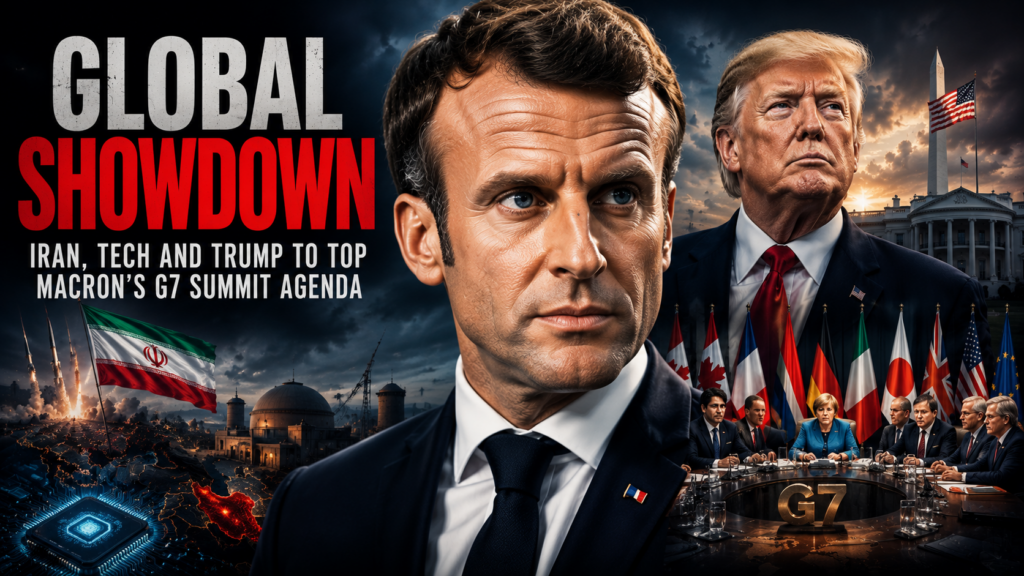
World leaders have gathered in Évian-les-Bains, France, for a crucial G7 summit focused on President Donald Trump, the Iran conflict, artificial intelligence, and global economic challenges. The three-day meeting comes at a critical time as leaders seek common ground on security, technology, and international trade.
According to a report by Euronews, French President Emmanuel Macron hopes to reduce tensions between the United States and its allies while advancing discussions on several major global issues.
What Happened
Leaders from the G7 nations arrived in Évian-les-Bains to discuss some of the world’s most pressing challenges. Their agenda includes the war in Ukraine, tensions in the Middle East, artificial intelligence regulation, and economic security.
However, attention quickly shifted to Iran after President Trump announced a breakthrough agreement aimed at ending the 15-week conflict. The announcement changed expectations for the summit and added urgency to discussions among allied leaders.
As a result, foreign policy has become the dominant theme of this year’s gathering.
Iran Agreement Reshapes the Summit Agenda
Diplomatic Breakthrough Draws International Attention
Trump said the agreement could help restore stability in the Middle East and reopen the Strait of Hormuz. The strategic waterway previously handled about 20% of global oil shipments.
Germany, France, the United Kingdom, and Italy welcomed the agreement and described it as a diplomatic breakthrough.
Meanwhile, Macron stressed the importance of restoring unrestricted maritime traffic through the region. He argued that open shipping routes are essential for global economic stability.
The Iran agreement is expected to be a major topic during Trump’s meetings with world leaders throughout the summit.
Readers interested in recent Middle East developments can also explore Trump’s phone discussions on Iran and regional security.
Why the Strait of Hormuz Matters
The conflict disrupted energy infrastructure and shipping routes across the region. Consequently, oil prices rose sharply while many countries searched for alternative energy supplies.
If the agreement succeeds, global energy markets could stabilize. In addition, lower transportation risks may help reduce pressure on fuel prices worldwide.
Ukraine Remains a Key Priority
Although Iran dominates headlines, Ukraine remains a central issue at the G7 summit.
Ukrainian President Volodymyr Zelenskyy is expected to participate in discussions about future military support and long-term security guarantees. European leaders also want to explore potential paths toward peace.
Furthermore, officials continue debating how Europe should position itself if future negotiations with Russia begin.
Many leaders believe Ukraine needs lasting security commitments rather than temporary assistance. Therefore, discussions are likely to focus on sustainable long-term solutions.
Artificial Intelligence Takes Center Stage
Technology Leaders Join High-Level Discussions
Artificial intelligence has become one of the summit’s most important topics.
French officials invited leading technology executives to participate in discussions about AI development and safety. Among those expected to attend are OpenAI CEO Sam Altman, Anthropic CEO Dario Amodei, and Mistral CEO Arthur Mensch.
Leaders want to balance innovation with security. At the same time, they hope to encourage responsible AI deployment across global markets.
For more on emerging technology policy, readers may also be interested in Trump administration AI investment initiatives and technology partnerships.
Concerns Over U.S. AI Restrictions
Recent U.S. restrictions on access to advanced AI models have raised concerns among European officials.
The measures affect some foreign users of cutting-edge artificial intelligence systems. As a result, policymakers plan to discuss whether such restrictions could affect cooperation between allies.
European officials argue that export controls should not unfairly impact partner nations. Therefore, AI regulation is likely to remain a major discussion point throughout the summit.
China Trade Challenges Return to the Agenda
China’s economic influence remains another important issue for G7 leaders.
Officials want to discuss trade imbalances, industrial subsidies, and economic pressure tactics. In addition, they hope to coordinate future responses to growing competition from Beijing.
Japanese Prime Minister Sanae Takaichi is expected to share insights from Japan’s experience handling trade disputes with China.
Moreover, European leaders are preparing for separate discussions later this week on economic relations with Beijing. The G7 summit could help shape those conversations.
Despite concerns, several officials emphasized the importance of keeping communication channels open with China.
What Happens Next
The summit will continue for three days as leaders work toward common positions on major international issues.
Several outcomes could emerge, including:
- More details about the Iran agreement.
- Additional support commitments for Ukraine.
- New approaches to AI governance.
- Greater cooperation on China-related trade challenges.
However, success will depend on whether leaders can overcome policy differences and reach meaningful agreements.
Conclusion
The G7 summit arrives at a pivotal moment for global politics. President Trump has become a central figure in discussions on Iran, Ukraine, artificial intelligence, and international trade.
Meanwhile, world leaders face growing pressure to address security threats, economic uncertainty, and rapid technological change. As a result, decisions made in France could influence global policy for months ahead.
If leaders find common ground, the summit may strengthen international cooperation on some of the world’s most urgent challenges.
The summit focuses on Iran, the Ukraine war, artificial intelligence, energy security, and global trade challenges.
The reported agreement could reopen the Strait of Hormuz, easing pressure on global energy markets and supporting regional stability.