The second amendment political debate continues to shape American presidential campaigns, congressional sessions, and judicial appointments more than any other constitutional issue. As the nation heads deeper into 2026, the divide between those advocating for expansive gun rights and those promoting stricter regulations has intensified, creating a defining fault line in U.S. governance. Presidential administrations from both major parties have approached this contentious issue with vastly different philosophies, making it essential for informed citizens to understand the historical context, legal interpretations, and political ramifications that drive this ongoing national conversation.
Historical Foundations and Modern Interpretations
The constitutional text of the Second Amendment appears deceptively simple, yet its interpretation has evolved dramatically since ratification. The historical context and interpretations of the Second Amendment reveal that early American leaders viewed militia service as central to national defense, creating debate about whether the amendment protects individual gun ownership or collective militia rights.
Key historical perspectives include:
- Federalist arguments emphasizing state militia independence from federal control
- Anti-federalist concerns about personal liberty and tyranny prevention
- 18th-century understanding of "arms" versus modern weaponry definitions
- Colonial-era self-defense traditions versus urbanization challenges
The National Constitution Center offers legal interpretations from diverse constitutional scholars, demonstrating how professional jurists disagree fundamentally on textual meaning. Some experts argue the "well regulated Militia" clause limits the scope to collective rights, while others contend the "right of the people" phrase establishes individual protection.
Supreme Court Precedents Reshaping the Landscape
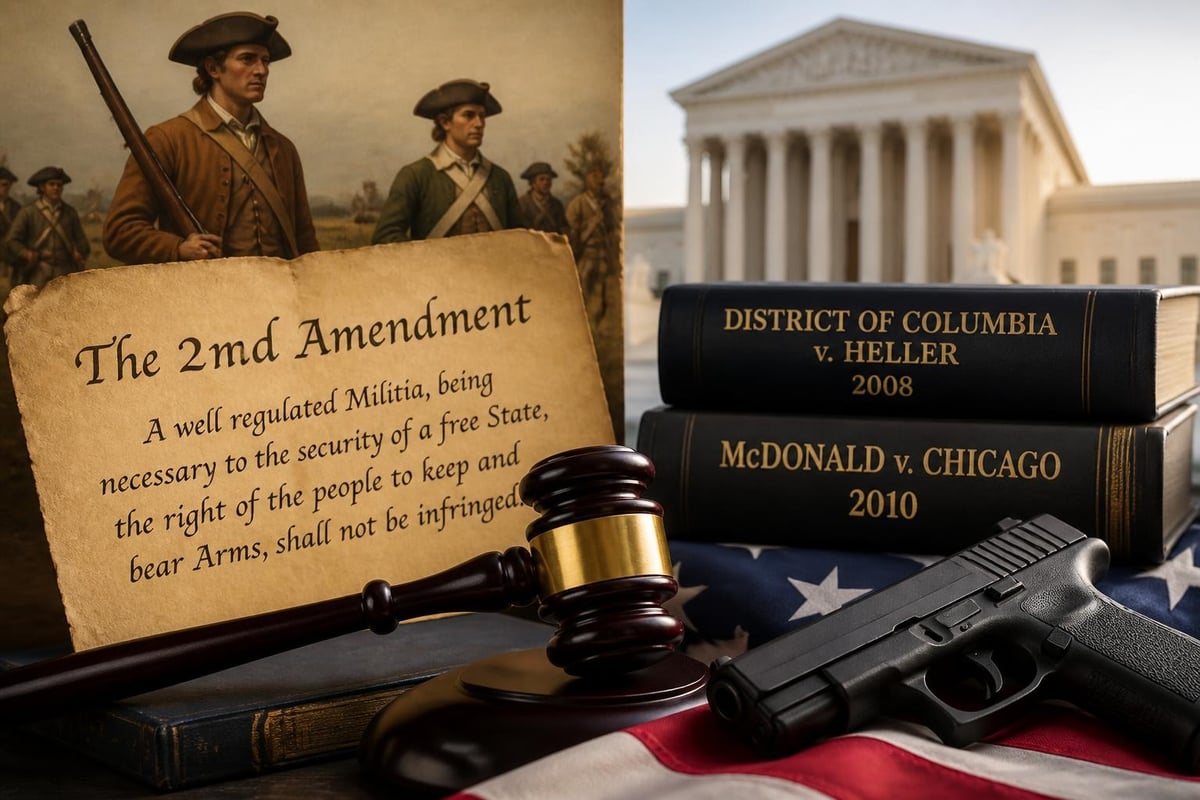
Landmark judicial decisions have fundamentally altered the second amendment political debate in recent decades. District of Columbia v. Heller (2008) represented a watershed moment by establishing an individual right to firearm ownership unconnected to militia service. This ruling invalidated Washington D.C.'s handgun ban and set new parameters for permissible regulation.
McDonald v. Chicago (2010) extended Heller's logic to state and local governments through the Fourteenth Amendment's incorporation doctrine. These precedents created constitutional floors below which gun regulations cannot descend, though they left significant questions unanswered about which specific restrictions pass constitutional muster.
| Case Name | Year | Key Holding | Political Impact |
|---|---|---|---|
| U.S. v. Miller | 1939 | Militia connection required | Limited individual rights interpretation |
| Heller v. D.C. | 2008 | Individual right established | Energized gun rights advocates |
| McDonald v. Chicago | 2010 | Applied to states | Invalidated local bans nationwide |
| NYSRPA v. Bruen | 2022 | Strict scrutiny standard | Expanded concealed carry rights |
The Supreme Court's current composition continues examining fundamental questions. Recent developments include the Court's consideration of whether state and local bans on semiautomatic rifles violate constitutional protections, a case that could reshape assault weapon legislation nationwide. These decisions ripple through presidential policy agendas and campaign platforms.
Presidential Approaches Across Administrations
Different presidents have embraced dramatically contrasting positions on firearms regulation, making gun policy a reliable predictor of broader governing philosophy. Democratic administrations typically prioritize public safety through enhanced background checks, assault weapon restrictions, and red flag laws. Republican administrations generally emphasize constitutional rights, opposing new federal mandates while supporting enforcement of existing statutes.
Presidential rhetoric shapes national conversation profoundly. Executive orders, Department of Justice enforcement priorities, and judicial appointments all flow from presidential leadership on this divisive issue. The domestic policy positions presidents adopt regarding firearms often define their relationships with Congress and determine legislative success on related initiatives.
Executive Actions and Legislative Proposals
Presidents frequently resort to executive action when Congress remains gridlocked on gun legislation. These measures include:
- Bureau of Alcohol, Tobacco, Firearms and Explosives (ATF) rule changes affecting definitions and enforcement
- Background check system improvements through administrative efficiency
- Federal agency coordination on prohibited purchaser databases
- Gun violence research funding through health agencies
- International arms trade restrictions impacting import regulations
Congressional proposals range from universal background checks to comprehensive assault weapon bans, yet partisan divisions typically prevent passage. Bipartisan legislation proves exceedingly rare, with most proposals dying in committee or falling victim to filibuster procedures.
The federal government occasionally takes enforcement actions highlighting constitutional tensions. A notable example involves the lawsuit against the U.S. Virgin Islands over restrictive permit requirements, demonstrating how executive branch priorities extend to territorial jurisdictions and local regulation schemes.
Partisan Divides and Electoral Implications
The second amendment political debate serves as a powerful mobilization tool for both major parties. Republican candidates typically frame gun ownership as fundamental liberty requiring protection from government overreach. Democratic candidates usually emphasize public health perspectives and mass shooting prevention through reasonable regulation.
Electoral consequences include:
- Single-issue voting patterns among gun rights advocates
- Suburban voter shifts following high-profile shootings
- Rural-urban geographic polarization on gun policy
- Fundraising advantages for candidates with clear positions
- Primary election litmus tests enforcing party orthodoxy
The political implications become especially pronounced following tragic events, when presidential responses and congressional inaction generate intense scrutiny. Candidates must balance competing pressures from activist bases demanding bold action against swing voters skeptical of government restriction.
Interest Group Influence and Grassroots Mobilization
Organized advocacy groups wield enormous influence over the second amendment political debate through campaign contributions, voter scorecards, and grassroots mobilization. The National Rifle Association historically dominated conservative activism, while organizations like Everytown for Gun Safety and Moms Demand Action have built progressive counterweights.
These groups shape primary elections through endorsements and independent expenditures. Presidential candidates seek their approval while navigating potential backlash from opposing coalitions. The resulting political calculus often produces carefully calibrated messaging designed to satisfy core supporters without alienating persuadable voters.
| Organization Type | Primary Argument | Key Tactics | Electoral Impact |
|---|---|---|---|
| Gun Rights Groups | Constitutional protection | Member mobilization, litigation | Republican primaries |
| Gun Safety Groups | Public health crisis | Suburban outreach, legislation | Democratic primaries |
| Law Enforcement | Officer safety concerns | Credibility appeals | Swing voters |
| Civil Liberties | Individual freedom | Coalition building | Libertarian voters |
Constitutional Scholarship and Academic Perspectives
Legal scholars continue debating original intent, textual interpretation, and appropriate judicial methodology for Second Amendment cases. Research on what the Second Amendment intended reveals historical complexities often simplified in political rhetoric. The framers' generation faced dramatically different threats, technologies, and social structures than contemporary America.
Originalist scholars argue modern interpretations must honor 18th-century understanding of militia service and arms-bearing. Living constitutionalists contend the amendment's principles should adapt to modern circumstances including automatic weapons and urban density. This methodological divide mirrors broader jurisprudential disagreements affecting numerous constitutional provisions.
The historical analysis of the Second Amendment demonstrates how debates over standing armies, state sovereignty, and individual liberty shaped the amendment's language. Presidential nominees to federal courts receive intense scrutiny regarding their constitutional philosophy on firearms, making judicial appointments a crucial battleground in the second amendment political debate.
Academic Research on Gun Violence and Policy Effectiveness
University researchers examine empirical questions about policy effectiveness that inform presidential decision-making. Studies investigate whether specific regulations reduce gun deaths, prevent mass shootings, or primarily burden law-abiding citizens. Methodological challenges and data limitations complicate efforts to establish causation definitively.
Academic symposia, such as those hosted by UC Berkeley examining Second Amendment myths, bring together historians, legal scholars, and policy analysts to explore multifaceted dimensions. These intellectual exchanges rarely penetrate partisan political messaging, yet they provide foundation for evidence-based policymaking when political will exists.

State-Level Experimentation and Federal Implications
State governments serve as laboratories for gun policy experimentation, creating diverse regulatory environments that inform national debates. Some states impose waiting periods, assault weapon bans, and magazine capacity limits. Others adopt constitutional carry provisions eliminating permit requirements entirely.
Presidential candidates frequently cite state examples supporting their positions. Those favoring regulation point to lower gun death rates in states with stricter laws. Those opposing new restrictions highlight defensive gun uses and argue criminals ignore regulations. The gun control debate explanation contextualizes how state variations create complex federal policy challenges.
Notable state approaches include:
- Universal background check requirements in 21 states
- Red flag laws enabling temporary firearm removal in crisis situations
- Assault weapon definitions varying dramatically across jurisdictions
- Concealed carry reciprocity creating interstate recognition disputes
- Permitless carry expansion in conservative-leaning states
Federal preemption questions arise when state laws conflict with national policy priorities. Presidents must navigate these tensions while respecting federalism principles, occasionally leading to federal lawsuits challenging state regulations or inadequate enforcement.
Media Coverage and Public Opinion Dynamics
News coverage significantly influences how Americans perceive the second amendment political debate. Mass shooting events generate intense media attention, temporarily elevating gun policy salience and creating pressure for presidential responses. Coverage patterns often emphasize tragedy while providing limited policy context or constitutional analysis.
Public opinion surveys reveal complex attitudes defying simple categorization. Majorities support specific measures like background checks while opposing others like assault weapon bans. Question wording dramatically affects results, and partisan identity increasingly predicts gun policy preferences regardless of personal firearm ownership.
Presidential communications strategies must account for these dynamics. Effective messaging requires balancing constitutional respect, public safety concerns, and political feasibility. The politics surrounding gun rights intersect with broader governance challenges including federalism, judicial restraint, and individual liberty.
Social Media's Amplification Effect
Digital platforms accelerate mobilization following gun violence incidents, creating pressure for immediate presidential statements. Hashtag campaigns, viral videos, and coordinated activism shape narratives before traditional policy processes engage. Presidents increasingly use social media to communicate positions directly, bypassing traditional media gatekeepers.
This acceleration sometimes produces poorly considered proposals or premature commitments that complicate subsequent legislative negotiations. The 24-hour news cycle and social media immediacy leave little space for deliberative policymaking, instead rewarding symbolic gestures and partisan positioning.
International Comparisons and American Exceptionalism
The second amendment political debate reflects uniquely American constitutional tradition without parallel in other developed democracies. International comparisons reveal dramatically different regulatory approaches producing varying outcomes. Australia's mandatory buyback program, Britain's handgun prohibition, and Switzerland's militia-based system each offer lessons presidential administrations cite selectively.
American gun ownership rates, estimated at 120 firearms per 100 residents, dwarf international comparisons. This reality shapes political feasibility regardless of theoretical policy preferences. Presidential proposals must account for hundreds of millions of existing firearms and constitutional protections that constrain available options.
Critics of American gun culture point to higher homicide rates compared to peer nations. Defenders emphasize defensive gun uses, sporting traditions, and constitutional rights distinguishing America from countries lacking similar founding documents. These competing narratives pervade presidential campaign rhetoric and policy justifications.
Future Trajectories and Emerging Issues
Technological developments introduce new dimensions to the second amendment political debate. Three-dimensional printing enables home firearm manufacturing, challenging traditional regulatory frameworks. Smart gun technology promises safety improvements while raising concerns about reliability and government tracking. Ghost guns lacking serial numbers complicate law enforcement efforts.
Presidential administrations will confront these emerging challenges requiring updated legal frameworks. The pace of technological change often exceeds legislative capacity, creating regulatory gaps that executive agencies attempt addressing through rule-making authority. These efforts inevitably generate litigation testing constitutional boundaries.
Demographic shifts may gradually alter political coalitions and policy possibilities. Younger voters express greater support for gun regulation, while suburban migration patterns potentially reshape electoral maps. Presidential candidates monitor these trends while attempting to build durable governing coalitions on firearms policy.
The gun rights and Supreme Court cases pipeline continues delivering new litigation testing regulatory limits. Lower court decisions applying recent Supreme Court precedents create circuit splits requiring high court resolution. Presidential judicial appointments therefore carry long-term implications extending beyond any single administration.
The second amendment political debate remains central to American governance, presidential elections, and constitutional interpretation. Understanding the historical foundations, legal precedents, partisan divisions, and emerging challenges equips citizens to evaluate presidential candidates and hold elected officials accountable. For comprehensive, non-partisan coverage of how current and past presidents approach this and other critical policy issues, U.S. Presidential Report provides the balanced analysis necessary for informed civic engagement. Stay informed about the latest developments in presidential policy and constitutional governance by exploring our extensive coverage of domestic policy debates.