American voters in 2026 face significantly different experiences depending on how they choose to cast their ballots. The divergence between mail-in ballot policies vs in-person voting rules 2026 has become one of the most discussed aspects of election administration, with state legislatures implementing varying requirements that shape voter access, security protocols, and the overall democratic process. Understanding these distinctions is essential for citizens, policymakers, and anyone following the evolving landscape of U.S. elections as we approach the midterm cycle.
Current State of Voting Methods in 2026
The United States operates under a federalist election system where states maintain considerable autonomy over voting procedures. This decentralized approach means that mail-in ballot policies vs in-person voting rules 2026 can differ dramatically from one jurisdiction to another.
Eight states currently conduct all-mail elections: California, Colorado, Hawaii, Nevada, Oregon, Utah, Vermont, and Washington. In these jurisdictions, every registered voter automatically receives a ballot by mail, though secure drop boxes and in-person voting centers remain available for those who prefer alternative methods.
Meanwhile, 34 states offer "no-excuse" absentee voting, allowing any registered voter to request a mail ballot without providing a specific reason. The remaining states require voters to meet certain criteria-such as age, disability, military service, or travel-to qualify for absentee voting.
Mail-In Ballot Request and Distribution Processes
The procedural requirements for obtaining a mail ballot vary substantially across states, representing a key difference in mail-in ballot policies vs in-person voting rules 2026.
Application deadlines range from 4 to 11 days before Election Day, with some states accepting requests up to the day before voting concludes. According to the U.S. Election Assistance Commission’s guidance on voting by mail, standardized processes help ensure ballot delivery and return timelines align with statutory deadlines.
States employ different verification methods during the request phase:
- Signature matching against voter registration records
- Partial Social Security number verification
- Driver's license or state ID number confirmation
- Date of birth authentication
- Witness or notary requirements in select jurisdictions
Some states mail applications automatically to all registered voters, while others require voters to initiate the request process through online portals, written applications, or phone calls to election offices.
Identification Requirements: A Critical Distinction
Perhaps no aspect of mail-in ballot policies vs in-person voting rules 2026 generates more debate than voter identification requirements, which differ substantially between voting methods.
In-Person Voting ID Standards
Thirty-six states request or require voters to show some form of identification at polling places. These requirements fall into distinct categories:
| ID Requirement Type | Number of States | Examples of Acceptable ID |
|---|---|---|
| Strict Photo ID | 9 | Driver's license, passport, military ID, state-issued photo ID |
| Non-Strict Photo ID | 12 | Same as above, but alternatives exist if ID not presented |
| Strict Non-Photo ID | 3 | Bank statement, utility bill, paycheck, government document |
| Non-Strict Non-Photo ID | 12 | Same as above, with alternative verification available |
States without ID requirements typically use signature verification or other identity confirmation methods when voters check in at their assigned precincts.
Mail Ballot Authentication Protocols
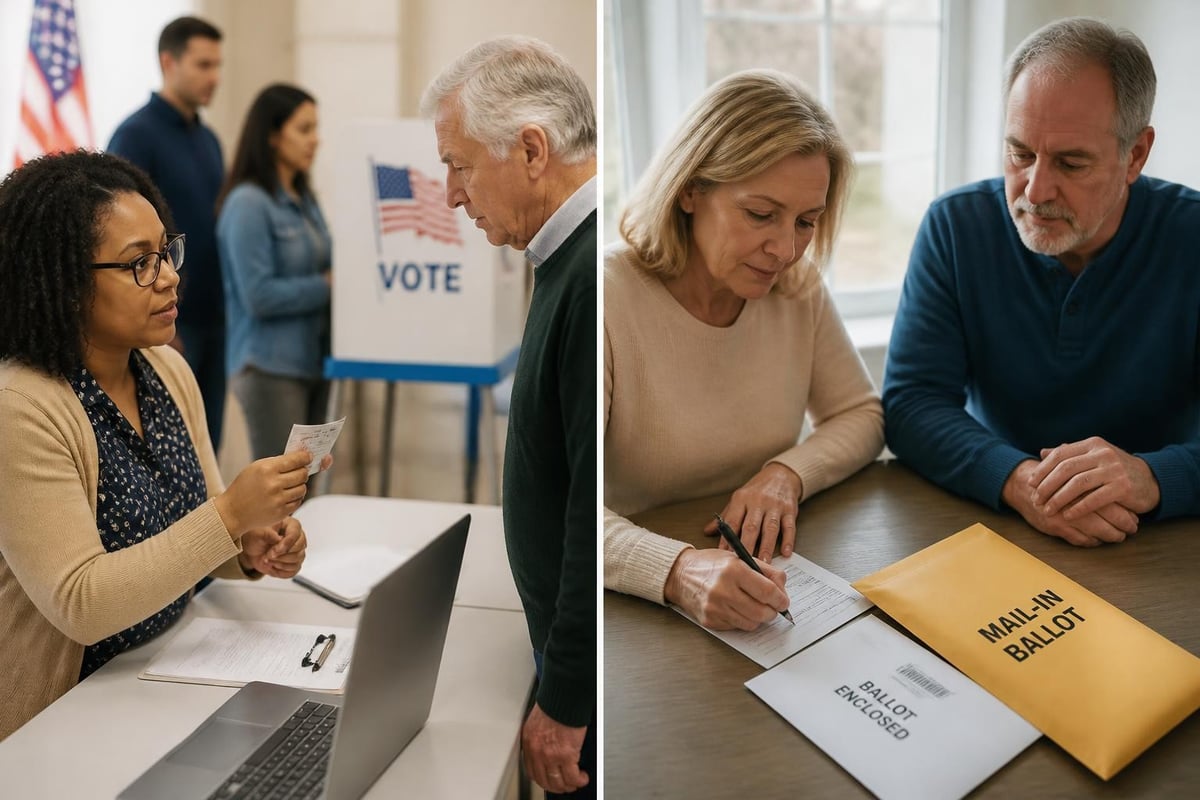
Mail ballot verification operates differently. Rather than presenting identification documents, voters typically authenticate their identity through:
- Signature matching: Election officials compare the signature on the ballot envelope with the signature on file from voter registration
- Witness signatures: Some states require one or more witnesses to sign the ballot envelope
- Notarization: A handful of states mandate notary verification for mail ballots
- ID number submission: Certain jurisdictions require voters to include driver's license or Social Security numbers
Research from the MIT Election Lab on voting by mail demonstrates that signature verification remains the most common authentication method, though error rates and cure processes vary considerably across states. These differences highlight fundamental contrasts in mail-in ballot policies vs in-person voting rules 2026.
Ballot Return Deadlines and Processing Windows
Timing requirements represent another significant dimension of mail-in ballot policies vs in-person voting rules 2026, with implications for both voter participation and election administration.
Return Deadline Variations
States apply three primary approaches to mail ballot return deadlines:
- Receipt by Election Day: Thirty-one states require mail ballots to arrive at election offices by the time polls close on Election Day, regardless of postmark date
- Postmark by Election Day: Nineteen states and the District of Columbia accept ballots postmarked by Election Day that arrive within specified windows (typically 3-17 days later)
- Hybrid systems: Some jurisdictions apply different rules for military and overseas voters
These deadline variations affect strategic voting decisions. The 2024 Election Administration and Voting Survey documented that ballot rejection rates correlate with deadline structures, with late-arriving ballots accounting for approximately 35% of all rejected mail ballots nationally.
In contrast, in-person voting offers certainty: voters who appear at their polling location during operating hours and complete the voting process successfully cast counted ballots, barring exceptional circumstances.
Early Voting and Processing Timelines
In-person early voting has expanded significantly, now available in 47 states and the District of Columbia. Early voting periods range from 4 to 45 days before Election Day, providing flexibility comparable to mail voting while retaining in-person verification procedures.
The processing of mail ballots begins at different times depending on state law:
- Pre-processing before Election Day: Twenty-three states allow election officials to begin verifying and preparing mail ballots before Election Day
- Processing on Election Day only: The remaining states prohibit any ballot processing until polls open on Election Day
- Counting restrictions: Even states permitting pre-processing often prohibit tabulating results until Election Day
This processing timeline difference explains why mail ballot results sometimes appear later than in-person vote tallies, a pattern that has generated public scrutiny and shaped perceptions of mail-in ballot policies vs in-person voting rules 2026.
Ballot Rejection and Cure Processes
Error rates and remediation procedures constitute a critical operational difference between voting methods, with direct implications for ballot counting and voter rights.
Common Rejection Reasons
Mail ballots face rejection for various administrative issues:
- Missing or mismatched signatures (43% of rejections nationally)
- Late arrival (35% of rejections)
- Missing voter signature (8% of rejections)
- Envelope issues or missing envelope (7% of rejections)
- Voter deceased or ballot already cast (4% of rejections)
- Voter not eligible (3% of rejections)
Analysis from the MIT Election Lab’s 2024 voting survey indicates that approximately 1.0% of all mail ballots submitted were rejected in the 2024 general election, down from 1.4% in 2020 as states refined processes and voter education improved.
In-person voting eliminates most rejection categories. Poll workers verify registration status and signature compliance before voters receive ballots, and ballot scanning equipment immediately identifies problems like overvotes or blank ballots, allowing voters to correct errors before leaving the polling place.
Cure Opportunities
Twenty-four states now provide formal "cure" processes allowing voters to correct mail ballot deficiencies, typically within 7-14 days after Election Day. Cure procedures vary:
Notification methods: Email, phone call, text message, or postal mail
Correction options: Signed affidavit, in-person verification, or additional documentation
Deadlines: Range from 2 to 14 days post-election
States without cure provisions simply reject deficient ballots without recourse, making the contrast in mail-in ballot policies vs in-person voting rules 2026 particularly consequential for voters who make procedural errors.
Security Measures and Chain of Custody
Both voting methods employ security protocols, though the mechanisms differ substantially given the distinct environments in which ballots are cast and handled.
In-Person Voting Security
Polling places implement multiple security layers:
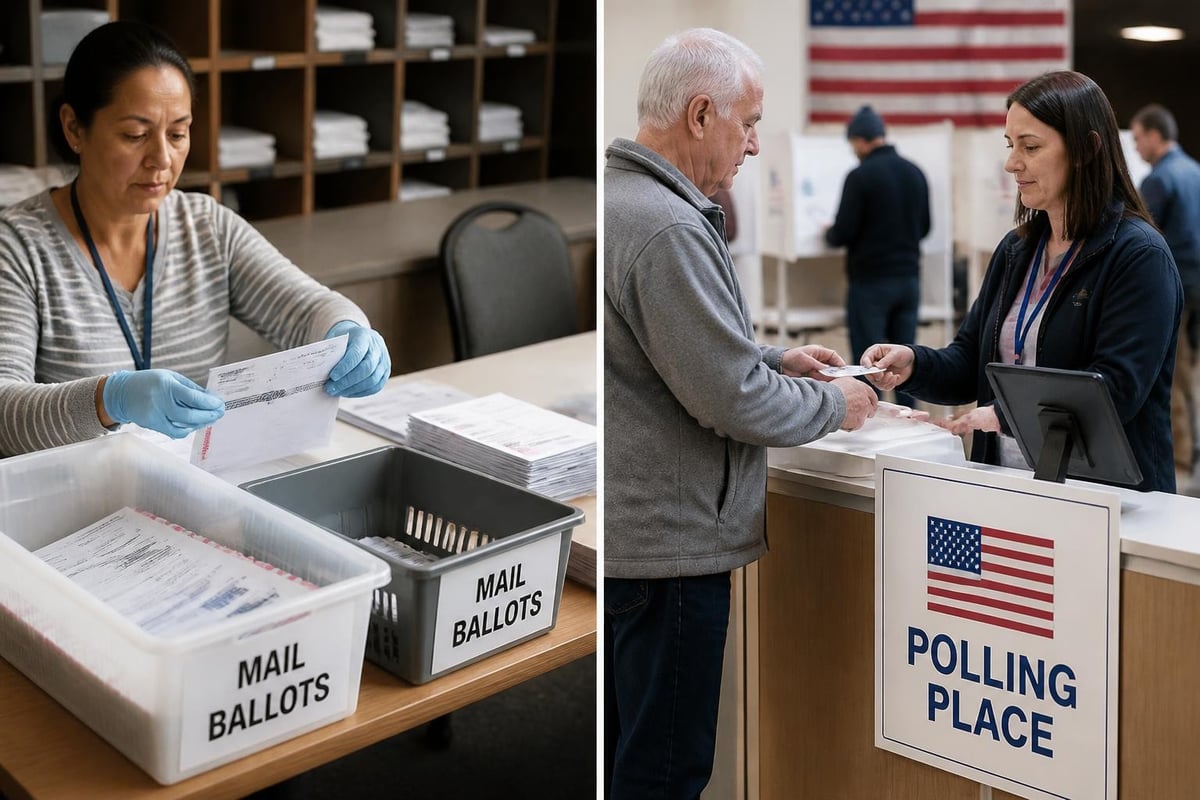
- Physical security: Poll workers, election observers, and sometimes law enforcement presence
- Registration verification: Electronic poll books confirm voter eligibility
- Equipment testing: Voting machines undergo pre-election logic and accuracy testing
- Paper trails: Most jurisdictions maintain paper records as backup
- Tamper-evident seals: Voting equipment sealed and monitored throughout Election Day
Mail Ballot Security Protocols
Mail voting requires different security approaches spanning a longer timeline:
| Security Element | Implementation Method | Purpose |
|---|---|---|
| Ballot tracking | USPS Intelligent Mail barcodes | Allow voters to monitor delivery and return status |
| Signature verification | Trained election staff review | Authenticate voter identity |
| Ballot secrecy | Inner secrecy sleeve | Separate identification from ballot choices |
| Drop box monitoring | Video surveillance, locks, regular pickup | Prevent tampering and theft |
| Chain of custody logs | Documented handling at each stage | Create audit trail |
The Brennan Center’s analysis of 2025 voting laws highlights that 14 states enacted enhanced security measures for mail voting in 2025, including ballot tracking requirements, drop box specifications, and signature verification standards.
Accessibility and Voter Participation Patterns
The choice between mail and in-person voting affects different demographic groups distinctly, shaping participation patterns and accessibility considerations relevant to understanding mail-in ballot policies vs in-person voting rules 2026.
Demographic Utilization Patterns
Recent voting data reveals clear patterns in method preference:
- Age: Voters over 65 use mail ballots at rates 25-30% higher than voters under 30
- Disability status: Voters with mobility limitations utilize mail voting at rates 40% higher than the general population
- Geographic location: Rural voters in states with limited polling place density increasingly rely on mail options
- Work schedules: Voters with inflexible work hours or multiple jobs report higher mail ballot usage
Accessibility Features
In-person voting locations must comply with Americans with Disabilities Act requirements, providing:
- Wheelchair-accessible entrances and voting booths
- Audio ballot interfaces for voters with visual impairments
- Curbside voting for those unable to enter facilities
- Assistance from poll workers or companions of the voter's choice
Mail voting offers accessibility advantages for voters unable to travel to polling places but presents challenges for voters with vision impairments, as most states do not provide accessible at-home ballot marking systems. Nine states now offer electronic ballot delivery for voters with disabilities, though the ballot must still be returned via mail or in-person drop-off.
The Congressional Research Service overview of voting options outlines the federal framework supporting accessible voting while acknowledging state-level implementation variations.
Operational Costs and Resource Allocation
Election administration budgets reflect the different resource demands of mail-in ballot policies vs in-person voting rules 2026, with implications for taxpayers and election officials.
In-Person Voting Costs
Traditional polling place operations require:
- Personnel: Poll worker recruitment, training, and compensation for Election Day and early voting periods
- Facilities: Rental fees for schools, community centers, and other voting locations
- Equipment: Voting machines, check-in systems, and supplies
- Logistics: Equipment transportation, setup, and retrieval
These costs concentrate around Election Day but have decreased in some jurisdictions as voter registration systems and voting equipment have become more efficient.
Mail Ballot Administration Expenses
Vote-by-mail systems involve different cost structures:
- Printing and postage: Ballot design, printing, and outbound/return postage
- Processing equipment: High-speed envelope openers, signature verification systems, and tabulation equipment
- Extended staffing: Pre-election processing requires weeks of staff time rather than single-day concentration
- Tracking systems: Technology investments for ballot tracking and voter notification
Analysis from the Brookings Institution on postal service election roles indicates that per-ballot costs for mail voting range from $2.15 to $3.25, compared to $1.75 to $2.50 for in-person voting, though these figures vary substantially based on local factors and existing infrastructure.
Legal Challenges and Policy Evolution
The regulatory landscape surrounding mail-in ballot policies vs in-person voting rules 2026 continues evolving through legislation and litigation, reflecting ongoing debates about election administration priorities. Readers interested in how federal policy shapes state-level decisions can explore additional context on U.S. Presidential Report, which provides comprehensive coverage of election policy developments.
Recent Legislative Trends
State legislatures have pursued divergent approaches since 2024:
Expansion measures (enacted in 18 states):
- Automatic mail ballot delivery to all registered voters
- Extended ballot return deadlines
- Additional drop box locations
- Pre-paid postage for return envelopes
- Enhanced ballot tracking systems
Restriction measures (enacted in 12 states):
- Shortened application deadlines
- Reduced early voting periods
- Limited drop box locations and hours
- Enhanced ID requirements for mail ballot requests
- Prohibited election officials from proactively sending applications
These competing legislative trends reflect fundamental disagreements about balancing access and security, making the comparison of mail-in ballot policies vs in-person voting rules 2026 increasingly complex.
Ongoing Litigation
Federal and state courts have addressed challenges to various aspects of election administration, with particular focus on:
- Signature verification standards and cure procedures
- Ballot receipt deadlines and postmark requirements
- Drop box regulations and monitoring requirements
- Third-party ballot collection (ballot harvesting) restrictions
- ID requirements for mail ballot applications
Court decisions in 2025 and early 2026 have produced mixed outcomes, with some courts striking down restrictive provisions while others have upheld state authority to implement specific security measures.
Voter Education and Information Dissemination
Successfully navigating mail-in ballot policies vs in-person voting rules 2026 requires voters to access accurate, timely information about procedures in their specific jurisdictions.
Information Sources and Voter Confusion
Election officials employ multiple communication channels:
- Official state election websites with method-specific guidance
- County and municipal election office resources
- Voter registration confirmation mailings
- Sample ballots showing voting method options
- Social media and text message notification systems
Despite these efforts, surveys indicate persistent voter confusion about method-specific requirements. Approximately 18% of voters in states with complex ID requirements reported uncertainty about what documents they needed to bring to polling places, while 22% of mail ballot voters expressed confusion about signature requirements and deadlines.
Comparative Voter Experience
Voters evaluate methods based on convenience, security perceptions, and trust:
Mail voting advantages cited by users:
- Ability to research candidates and issues while completing the ballot
- Elimination of transportation and scheduling challenges
- Privacy of voting at home
- No need to request time off work
In-person voting advantages cited by users:
- Immediate confirmation that ballot was cast and counted
- Assistance from poll workers with questions
- Civic experience and community participation
- No concerns about mail delivery or signature matching
Understanding these preference patterns helps explain why many states maintain robust infrastructure for both methods rather than consolidating around a single approach, reinforcing the ongoing relevance of comparing mail-in ballot policies vs in-person voting rules 2026.
Federal-State Coordination and Oversight
While states administer elections, federal agencies provide guidance, funding, and oversight that shapes how mail-in ballot policies vs in-person voting rules 2026 function in practice.
The U.S. Election Assistance Commission develops voluntary guidance, distributes federal election administration funds, and maintains the National Voter Registration Form. The Department of Justice enforces federal voting rights laws, monitors jurisdictions with histories of discrimination, and investigates allegations of voter suppression or intimidation.
Congress appropriated $840 million in election security grants between 2018 and 2024, funding upgrades to voting equipment, cybersecurity enhancements, and ballot processing systems. These federal resources have enabled states to modernize infrastructure supporting both in-person and mail voting, though distribution formulas and state matching requirements create variations in implementation capacity.
The Help America Vote Act requires states to maintain computerized voter registration databases and provide provisional voting opportunities when eligibility questions arise at polling places. These federal baseline requirements establish minimum standards while permitting state-level variation in specific procedures.
Understanding the nuanced differences between mail-in ballot policies vs in-person voting rules 2026 is essential for anyone following American elections and democratic processes. These distinct frameworks reflect state-level decisions balancing accessibility, security, and administrative capacity in ways that directly affect voter participation and election outcomes. For comprehensive, non-partisan coverage of how presidential leadership influences election policy and ongoing developments in voting administration, U.S. Presidential Report provides timely analysis and detailed reporting on the policies shaping American democracy. Stay informed about the evolving landscape of election administration and its implications for presidential governance by exploring our extensive coverage of current and historical presidential impacts on voting rights and electoral processes.