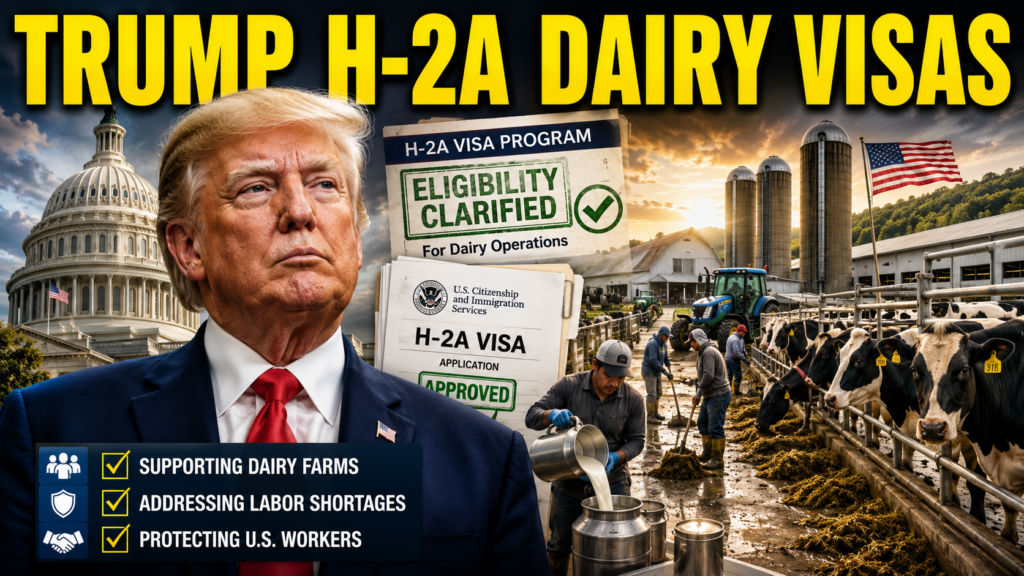
The Trump administration has issued new guidance clarifying that dairy farms may qualify for the H-2A visa program when they can demonstrate a temporary or seasonal labor need. The decision provides greater certainty for dairy producers facing workforce shortages while maintaining existing protections for U.S. workers.
What Happened
According to a report by the U.S. Department of Agriculture, the U.S. Department of Homeland Security and the U.S. Department of Labor have clarified how H-2A petitions submitted by dairy operations will be evaluated.
Under the updated policy guidance, U.S. Citizenship and Immigration Services will assess dairy related H-2A petitions using the same statutory and regulatory standards applied to other agricultural employers. Officials will continue reviewing each application individually to determine whether the employer can demonstrate a qualifying temporary or seasonal labor need.
Key Details of the H-2A Visa Clarification
Dairy Operations May Qualify for H-2A Workers
Federal agencies confirmed that dairying is considered an agricultural activity eligible for consideration under the H-2A temporary agricultural worker program. The guidance also recognizes that dairy operations may experience temporary or seasonal labor demands that could satisfy program requirements.
Existing Rules Remain in Place
The clarification does not create a new visa category and does not automatically expand eligibility for dairy employers.
Instead, it provides additional guidance on how existing immigration laws should be applied when dairy farms seek access to the H-2A program. USCIS will continue reviewing petitions on a case by case basis.
Current Application Procedures Still Apply
Dairy employers seeking eligible workers may continue using the same H-2A application process already available to agricultural employers across the country. Employers must still satisfy all program requirements before approval can be granted.
Impact on the Dairy Industry
Labor shortages remain one of the biggest challenges facing dairy producers throughout the United States.
Unlike many crop operations that rely on seasonal labor, dairy farms often require workers year round. This difference has created uncertainty regarding H-2A eligibility for many producers over the years.
Industry groups welcomed the clarification and argued that it provides a clearer pathway for dairy operations experiencing temporary labor shortages. Supporters believe the guidance could help stabilize production while allowing farms to address workforce needs through existing legal channels.
At the same time, several agricultural organizations continue to advocate for broader reforms that would address long term labor challenges facing the industry.
The announcement comes as demand for H-2A workers continues to increase nationwide, reflecting growing workforce needs across the agricultural sector.
Immigration Policy Context
The clarification arrives amid broader discussions about immigration policy and workforce development under President Donald Trump.
Recent policy debates have focused on border security, legal immigration pathways and labor market demands. The latest guidance reflects ongoing efforts to clarify how existing immigration programs can support critical industries while maintaining regulatory oversight.
Readers interested in related immigration developments can also review Trump Green Card Policy Adjustment Status and Trump Immigration Funding Bill Boosts ICE and CBP Resources for additional context on recent federal immigration initiatives.
What Happens Next
Dairy employers seeking H-2A workers must continue demonstrating that their labor need is temporary or seasonal. They must also comply with all federal program requirements throughout the application process.
USCIS will continue evaluating petitions individually under existing regulations.
While the guidance provides greater clarity for dairy producers, industry leaders and agricultural organizations are expected to continue pushing for broader reforms aimed at modernizing agricultural workforce programs and addressing long term labor shortages.
Conclusion
The Trump administration’s clarification on H-2A visa eligibility represents an important development for the U.S. dairy industry. By confirming that dairy employers may qualify for the program when they can demonstrate a temporary or seasonal labor need, federal agencies have provided greater certainty for farmers while preserving existing legal safeguards.
The decision could help reduce workforce challenges across the dairy sector and support agricultural productivity. At the same time, it highlights the continuing role immigration policy plays in addressing labor needs across key American industries as policymakers debate future reforms.
Yes. Dairy operations may use the H-2A program if they can demonstrate a qualifying temporary or seasonal labor need under existing law.
No. The clarification does not create a new visa category and does not change existing H-2A legal requirements.