The way Americans access information about their presidents has fundamentally changed in the digital age. Google processes billions of searches daily, serving as the primary gateway through which citizens discover news about presidential policies, elections, and governance. However, growing concerns about algorithmic fairness have sparked intense scrutiny of how search results are generated and displayed. The google search bias debate explained encompasses questions about political neutrality, personalization effects, and the responsibility technology companies bear in shaping public discourse around presidential matters.
Understanding the Core Allegations
Search bias refers to systematic patterns in search results that favor certain perspectives, sources, or information types over others. Critics argue these patterns can influence public perception of presidential actions and political events.
The debate centers on several key allegations. Some researchers claim search algorithms favor established news outlets over independent journalism, potentially limiting diverse viewpoints on presidential policies. Others point to personalization features that may create echo chambers, where users primarily encounter information confirming their existing political beliefs.
Major concerns include:
- Political slant in news rankings during presidential elections
- Geographic bias affecting local versus national political coverage
- Commercial interests influencing placement of political content
- Algorithmic amplification of sensational over substantive presidential news
The technical complexity of modern search systems makes bias difficult to detect and measure consistently. Search engines employ hundreds of ranking factors, many operating through machine learning systems that evolve continuously without direct human oversight.

The Role of Personalization in Political Searches
Google's personalization algorithms tailor search results based on user history, location, and behavior patterns. While this improves relevance for many queries, it raises significant questions when applied to political information.
Researchers say Google AI Mode changes recommendations based on your emails, potentially creating confirmation bias machines that reinforce existing political viewpoints. When citizens search for information about presidential decisions or policy positions, the results they receive may reflect their previous browsing patterns rather than presenting balanced perspectives.
Filter Bubbles and Presidential Information Access
The filter bubble effect occurs when personalization limits exposure to challenging viewpoints. A voter researching presidential candidates might receive dramatically different search results than their neighbor based solely on algorithmic profiling.
This personalization applies across multiple dimensions:
- Search history influence shapes which news sources appear prominently
- Location-based filtering prioritizes regional political coverage
- Device and platform preferences affect content formatting and source selection
- Social signals from connected accounts may influence political content visibility
The implications for democratic discourse are substantial. When the google search bias debate explained reveals that citizens access fundamentally different information about the same presidential actions, it challenges the notion of shared factual grounding necessary for productive political dialogue.
| Personalization Factor | Impact on Political Content | Transparency Level |
|---|---|---|
| Search History | High – shapes source rankings | Low |
| Geographic Location | Medium – affects local news | High |
| Gmail Activity | High – influences AI recommendations | Very Low |
| Social Connections | Medium – shapes trending topics | Low |
AI Overviews and Information Accuracy
Google's integration of AI-generated summaries at the top of search results introduces new dimensions to the bias discussion. These AI Overviews condense information from multiple sources, but Google’s AI Overviews are often so confidently wrong that trust issues emerge.
For presidential news consumers, AI-generated summaries present particular challenges. Political information often requires nuance, context, and acknowledgment of competing interpretations. When AI systems generate summaries about presidential policies or political controversies, they may inadvertently strip away essential complexity or present partisan interpretations as factual consensus.
The shift to AI-driven search feels like a digital reimagining of information access itself, fundamentally altering how citizens encounter presidential news. These systems increasingly draw from user-generated content platforms, which may lack the editorial standards traditional news organizations maintain.
Technical Limitations and Algorithmic Challenges
Google acknowledges technical challenges in its search algorithms that can lead to biased results. The company faces genuine difficulties in creating politically neutral algorithms.
Machine learning systems learn patterns from training data that reflects existing biases in media coverage and public discourse. When these systems rank presidential news content, they may perpetuate rather than correct for systematic imbalances in how different political perspectives receive coverage.
Key technical challenges include:
- Training data that reflects historical media biases
- Difficulty defining "neutrality" in politically contested topics
- Optimization for engagement metrics that favor sensational content
- Lack of diverse perspectives in algorithm development teams
Content moderation presents additional complications. Distinguishing between legitimate political speech and misinformation requires editorial judgment that automated systems struggle to replicate. When search engines attempt to downrank false information about presidential matters, they face accusations of political censorship from those whose content is affected.

The SEO Industry's Contribution
The google search bias debate explained must account for how search engine optimization practices shape result rankings. SEO professionals contribute to search bias through optimization techniques that prioritize visibility over informational value.
Political organizations, advocacy groups, and media outlets employ sophisticated SEO strategies to dominate search results for presidential keywords. These efforts create competitive dynamics where well-resourced organizations can effectively purchase visibility through technical optimization rather than earning it through journalistic merit.
Gaming the System for Political Advantage
Campaign organizations and political action committees understand that controlling search results for candidate names or policy issues translates into electoral advantage. They invest heavily in strategies designed to ensure favorable content ranks prominently when voters research presidential candidates.
Common tactics include:
- Creating networks of supportive websites linking to preferred content
- Optimizing for long-tail keywords voters use when researching specific issues
- Rapid content creation to dominate "news" results during breaking events
- Strategic use of social signals to boost content visibility
- Negative SEO targeting opposition content
These practices exist in a gray area between legitimate political communication and manipulation of information systems. The challenge for search engines involves distinguishing between popular, relevant content and artificially amplified material designed primarily for algorithmic manipulation.
Academic Research and Query Bias
Research into search bias extends beyond commercial search engines to academic platforms. An academic paper examining biased queries in Google Scholar demonstrates how the phrasing of search queries themselves introduces bias into results.
When citizens search for information about presidential actions using politically charged language, they receive results aligned with that framing. Someone searching "presidential overreach executive orders" encounters different content than someone querying "presidential leadership executive action," even when both seek information about the same governmental activity.
| Query Framing | Typical Result Characteristics | Implicit Bias |
|---|---|---|
| "Presidential leadership on…" | Positive framing, supportive sources | Pro-administration |
| "Presidential failure to…" | Critical framing, opposition sources | Anti-administration |
| "Presidential policy regarding…" | Neutral framing, diverse sources | Minimal |
| "Presidential scandal involving…" | Negative framing, investigative sources | Critical |
This query-level bias compounds algorithmic bias, creating situations where users' preexisting viewpoints shape both what they search for and what algorithms deliver. For readers seeking balanced information about presidential policy decisions, this presents significant obstacles to accessing comprehensive perspectives.
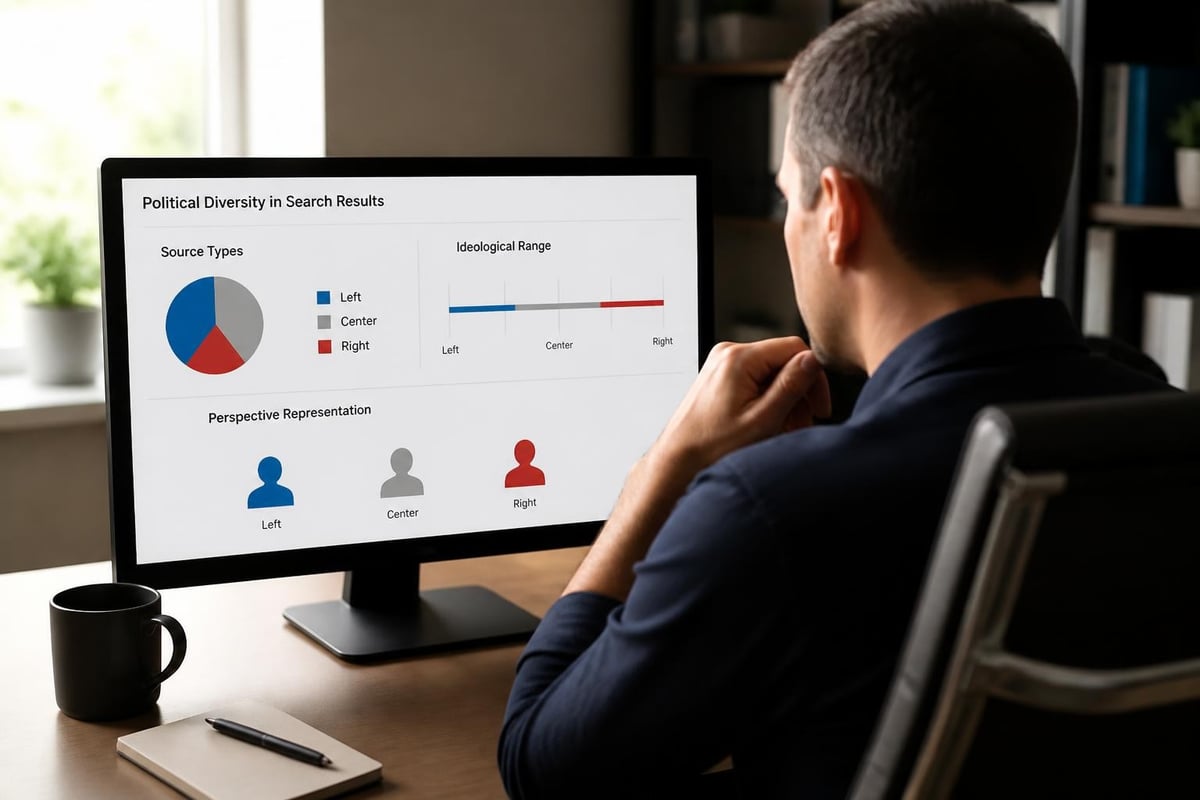
Political Asymmetry in Search Results
Evidence suggests search bias may affect different political perspectives asymmetrically. Some studies indicate conservative sources face greater algorithmic challenges than progressive outlets, while other research suggests the opposite pattern for specific query types.
The question of political asymmetry remains contentious and difficult to measure objectively. Defining what constitutes "balanced" coverage of inherently partisan topics involves subjective judgments about which sources deserve prominence and what constitutes fair representation.
Factors complicating asymmetry analysis:
- Different political communities exhibit varying trust in mainstream versus alternative media
- Source authority metrics may reflect institutional bias rather than content quality
- Fact-checking organizations themselves face accusations of political slant
- User engagement patterns differ across political communities, affecting algorithmic learning
When examining coverage of presidential actions and controversies, these measurement challenges become acute. Reasonable observers disagree about whether search results favor particular political perspectives because they fundamentally disagree about what balanced coverage should look like.
Commercial Pressures and Editorial Independence
Google operates as a commercial enterprise with financial incentives that may conflict with purely neutral information delivery. Advertising revenue depends on user engagement, creating pressure to surface content that attracts clicks rather than material offering the most balanced presidential news coverage.
News organizations optimizing for search visibility face similar commercial pressures. Stories generating strong emotional responses attract more engagement, encouraging coverage emphasizing conflict and controversy over nuanced policy analysis. When these commercial incentives align with algorithmic preferences for high-engagement content, they amplify tendencies toward sensationalism in presidential news.
The Business Model Problem
The fundamental challenge involves reconciling search engines' business interests with their role as primary information gatekeepers for political knowledge. No obvious solution exists that satisfies both commercial viability and democratic information needs.
Publishers competing for search visibility must balance journalistic integrity against algorithmic optimization. Those who refuse to adapt their presidential news coverage to search algorithm preferences risk invisibility, while those who optimize aggressively may compromise editorial standards.
Transparency and Accountability Mechanisms
Critics argue that Google's algorithmic opacity prevents meaningful accountability for bias. The company treats specific ranking factors as proprietary trade secrets, making independent verification of neutrality claims difficult.
Several proposals aim to increase transparency:
- Mandatory disclosure of major algorithmic changes affecting political content
- Independent audits of search result composition for politically sensitive queries
- User controls allowing adjustment of personalization intensity
- Clear labeling of AI-generated versus human-created summaries
- Public datasets enabling bias research without compromising trade secrets
Implementation faces significant obstacles. Detailed transparency could enable manipulation by those seeking to game rankings. Privacy concerns limit what user-level data can be shared for research. Competitive pressures discourage voluntary disclosure that might advantage rivals.
International Perspectives and Comparative Approaches
The google search bias debate explained extends beyond American politics to encompass how search engines handle political information globally. Different countries adopt varying regulatory approaches to addressing perceived bias.
European authorities pursue more aggressive regulation than their American counterparts, implementing requirements for algorithmic transparency and content moderation. These regulatory differences create tension between uniform global platforms and diverse national expectations for political neutrality.
Some democracies mandate that search engines provide balanced political coverage during election periods, while others rely on market competition and media literacy to address bias concerns. The effectiveness of these different approaches remains subject to ongoing debate and research.
User Agency and Information Literacy
Beyond algorithmic solutions, many experts emphasize information literacy as essential for navigating search bias. Citizens who understand how search algorithms function can employ strategies to access more diverse perspectives on presidential matters.
Practical steps for informed searching:
- Using multiple search engines to compare results
- Explicitly seeking sources across the political spectrum
- Examining search results beyond the first page
- Disabling personalization features when researching political topics
- Directly visiting trusted news sources rather than relying solely on search
These individual strategies cannot fully address systematic bias, but they provide citizens with greater agency in their information consumption. When researching presidential elections and policy decisions, employing diverse information sources becomes particularly important.
The Evolving Nature of Search Bias
The google search bias debate explained continues evolving as search technology advances. Today's concerns about personalization and AI summaries will likely be supplemented by new challenges as generative AI becomes more deeply integrated into search experiences.
Future developments may include:
- Conversational search interfaces that provide single answers rather than multiple sources
- Predictive search anticipating information needs before explicit queries
- Multimodal search combining text, image, and voice inputs with complex interpretation challenges
- Embedded search within platforms that blend content and search seamlessly
Each technological evolution introduces new opportunities for bias while potentially addressing existing concerns. The fundamental tension between personalized relevance and neutral information access will likely persist regardless of specific technical implementations.
Understanding search bias remains essential for anyone seeking balanced information about presidential politics and governance. As algorithms increasingly mediate access to political knowledge, recognizing their limitations and potential biases becomes a critical component of informed citizenship. For readers committed to accessing comprehensive, non-partisan coverage of presidential matters, U.S. Presidential Report offers dedicated news and analysis designed to cut through algorithmic filtering and deliver balanced perspectives on current and past presidents.