The economic impact of illegal immigration remains one of the most debated policy issues in American governance, with presidential administrations approaching the topic from vastly different perspectives. Understanding the multifaceted economic consequences requires examining labor market dynamics, fiscal contributions and costs, wage effects across industries, and broader macroeconomic implications. This analysis synthesizes research from economic institutions, government agencies, and academic sources to provide a comprehensive view of how unauthorized immigration affects the U.S. economy in 2026.
Labor Market Dynamics and Unauthorized Workers
Unauthorized immigrants constitute a significant portion of the American workforce, particularly in industries where employers face persistent labor shortages. According to recent estimates, approximately 8 million unauthorized workers participate in the U.S. labor force, representing roughly 5% of total employment.
Industry Concentration and Economic Dependency
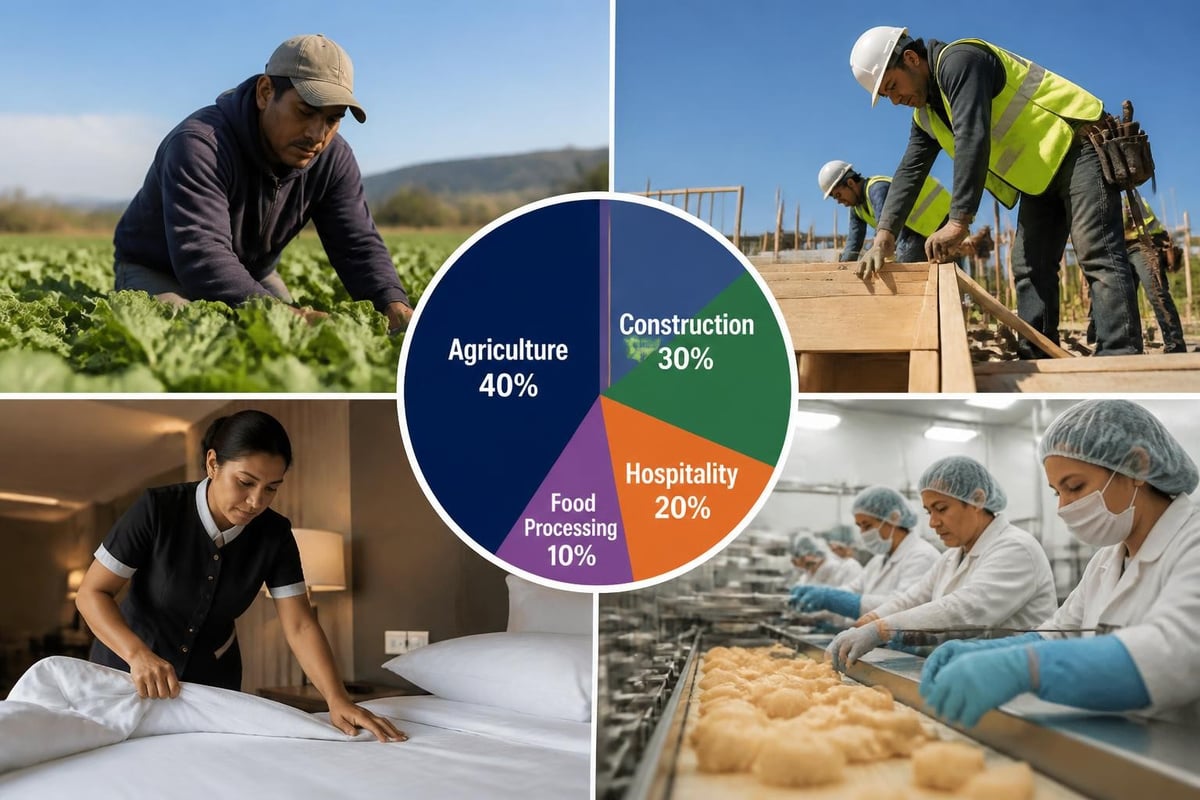
The distribution of unauthorized workers across industries reveals critical dependencies in several economic sectors. Agriculture, construction, hospitality, and food services employ the highest concentrations of unauthorized labor, with some regions experiencing dependence rates exceeding 20% of their workforce in specific industries.
Key sectors with high unauthorized labor participation:
- Agriculture and crop production (15-25% of workforce)
- Construction and building maintenance (12-18% of workforce)
- Food processing and manufacturing (10-15% of workforce)
- Hospitality and accommodation services (8-12% of workforce)
- Landscaping and grounds maintenance (18-22% of workforce)
Research on the domestic economic impacts of immigration demonstrates that unauthorized workers often fill positions that face chronic recruitment challenges among native-born workers. These roles typically involve physically demanding labor, irregular schedules, or wages below what domestic workers accept without supplemental benefits.
Employment Competition and Complementarity
The question of whether unauthorized workers compete with or complement native-born workers depends heavily on skill levels and geographic markets. Workers without high school diplomas face the most direct competition from unauthorized immigrants, experiencing measurable wage suppression in certain markets.
However, analysis of immigration’s effect on the U.S. economy indicates that higher-skilled native workers often benefit from unauthorized immigration through complementary relationships. When unauthorized workers fill manual labor positions, native-born workers frequently move into supervisory, administrative, and technical roles that require citizenship or legal status.
| Worker Category | Primary Effect | Wage Impact | Employment Impact |
|---|---|---|---|
| High school dropouts | Competition | -2% to -5% | Minimal to moderate |
| High school graduates | Mixed | -1% to +1% | Neutral |
| College educated | Complementary | +2% to +4% | Positive |
| Specialized technical | Complementary | +3% to +6% | Positive |
Fiscal Contributions and Public Spending
The fiscal impact of the economic impact of illegal immigration involves complex calculations of tax contributions versus public service consumption. Unauthorized immigrants contribute substantially to federal, state, and local tax revenues while having limited access to many government benefit programs.
Tax Revenue Generation
Despite their unauthorized status, most unauthorized immigrants pay significant taxes through multiple channels. These workers contribute an estimated $12 billion annually in state and local taxes, with sales taxes, property taxes (directly or through rent), and payroll taxes representing the largest revenue sources.
Primary tax contribution mechanisms:
- Federal Insurance Contributions Act (FICA) taxes on wages
- State and local sales taxes on consumer purchases
- Property taxes through rent or homeownership
- Excise taxes on fuel, alcohol, and tobacco
- Business taxes from unauthorized entrepreneurs
The Social Security Administration estimates that unauthorized workers contribute approximately $13 billion annually to Social Security through payroll taxes, funds they cannot claim in retirement benefits. This represents a net positive contribution to a system facing long-term funding challenges.
Public Service Costs and Benefit Limitations
Examining the cost of illegal immigration reveals that unauthorized immigrants generate fiscal costs primarily through education, emergency healthcare, and law enforcement services. However, their ineligibility for most federal benefit programs limits their fiscal impact compared to legal residents.
Unauthorized immigrants cannot access:
- Federal unemployment insurance
- Supplemental Nutrition Assistance Program (SNAP)
- Supplemental Security Income (SSI)
- Medicare (except emergency services)
- Affordable Care Act subsidies
- Most Medicaid services (except emergency care)
The largest fiscal cost stems from K-12 education for children of unauthorized immigrants, a constitutionally protected right established in Plyler v. Doe (1982). State and local governments bear approximately $60 billion annually in education costs for these students, though many will enter the legal workforce and become taxpayers as adults.

Wage Effects Across Economic Sectors
The economic impact of illegal immigration on wages varies dramatically by industry, skill level, and regional labor markets. Presidential administrations have historically approached wage protection through different enforcement strategies, affecting both unauthorized workers and employers.
Wage Suppression in Low-Skill Markets
Industries with high concentrations of unauthorized workers typically experience wage compression, particularly for entry-level and low-skill positions. Construction laborers, agricultural workers, and food service employees in markets with substantial unauthorized populations earn 10-25% less than comparable workers in markets with minimal unauthorized labor.
This wage suppression occurs through several mechanisms:
- Employer leverage from workers' limited legal recourse
- Increased labor supply reducing workers' bargaining power
- Cash payment systems avoiding minimum wage enforcement
- Fear of deportation preventing workplace complaints
However, research on the economic logic of illegal immigration suggests that these wage effects remain concentrated in specific geographic markets and industries rather than affecting the entire economy uniformly.
Wage Benefits for Complementary Workers
While some workers face wage competition, others benefit from the presence of unauthorized labor. Skilled tradespeople, project managers, and specialized technicians often command higher wages in markets with robust unauthorized labor forces because construction and agricultural projects can scale efficiently.
| Occupation Type | Wage Effect | Mechanism | Geographic Variation |
|---|---|---|---|
| General laborers | -8% to -15% | Direct competition | High in border states |
| Skilled trades | +3% to +8% | Complementary roles | Moderate nationwide |
| Professional services | +4% to +10% | Expanded business scale | Low variation |
| Management positions | +6% to +12% | Supervision demand | Moderate in high-immigration areas |
Regional Variations in Economic Impact
The economic impact of illegal immigration manifests differently across regions based on industry composition, existing labor markets, and enforcement priorities. Border states experience more pronounced effects than interior states, while agricultural regions face different dynamics than urban service economies.
Presidential policy decisions regarding infrastructure and city services directly influence how communities experience these economic effects, particularly regarding public service provision and local tax bases.
Consumer Demand and Price Effects
Unauthorized immigrants function as both workers and consumers, generating substantial economic activity through their household spending. This dual role creates ripple effects throughout local and national economies that often receive less attention than labor market impacts.
Consumer Spending Contributions
Unauthorized immigrant households contribute approximately $120 billion annually to U.S. consumer spending across housing, food, transportation, and other necessities. This spending supports jobs in retail, real estate, automotive, and service industries where workers typically have legal status.
The consumer demand generated by unauthorized immigrants supports an estimated 1.4 million jobs held by native-born workers in retail, service, and support industries. These positions exist because unauthorized workers and their families require housing, groceries, clothing, transportation, and other goods and services.
Major spending categories for unauthorized immigrant households:
- Housing costs (rent, utilities, maintenance): 35-40% of income
- Food and groceries: 15-20% of income
- Transportation (vehicles, fuel, insurance): 12-18% of income
- Healthcare (out-of-pocket, uninsured): 8-12% of income
- Communications and technology: 5-8% of income
Price Effects on Consumer Goods
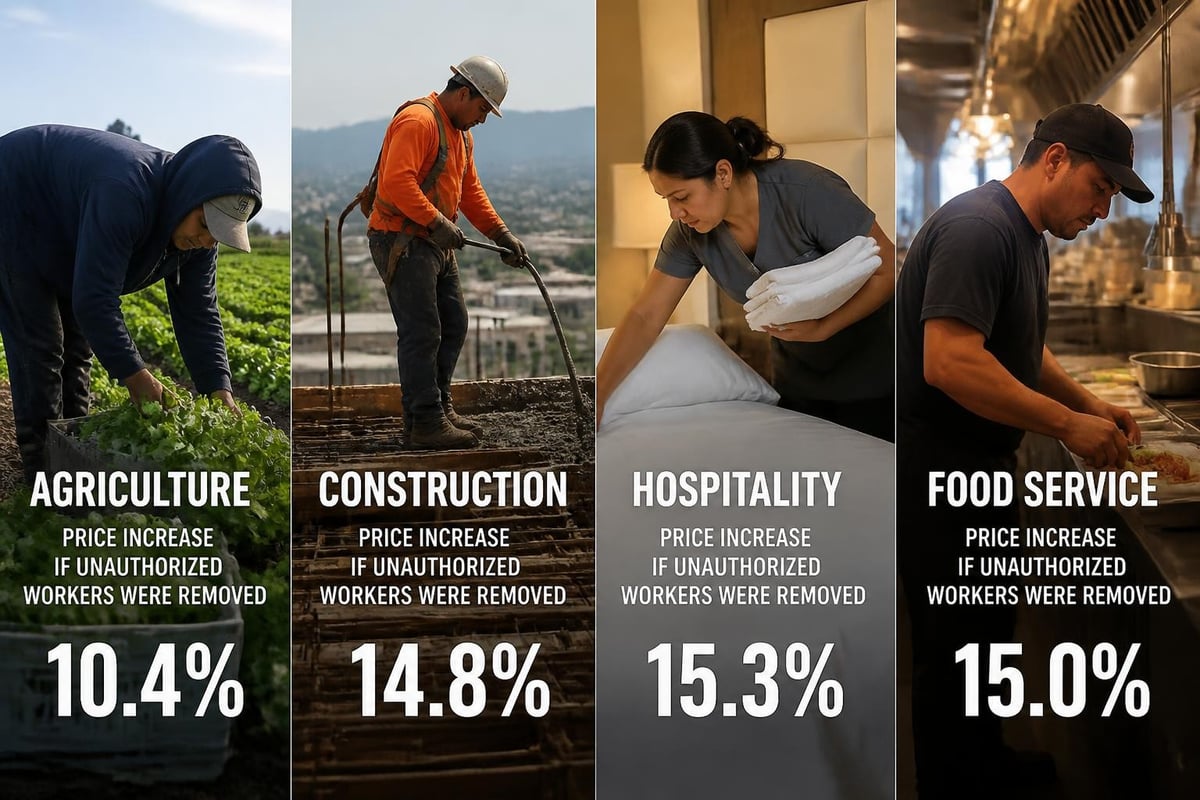
The availability of unauthorized labor affects consumer prices in industries with high concentrations of these workers. Agricultural products, restaurant meals, new home construction, and landscaping services cost substantially less than they would without access to unauthorized labor.
Economic modeling suggests that complete removal of unauthorized workers would increase:
- Fresh produce prices by 25-40%
- Restaurant meal costs by 15-25%
- New home construction prices by 10-20%
- Hotel accommodation rates by 12-18%
- Landscaping and grounds maintenance by 20-30%
These price increases would disproportionately affect middle and lower-income consumers who spend higher percentages of their income on food, housing, and basic services.
Agricultural Sector Dependencies
Agriculture represents the most economically vulnerable sector regarding unauthorized immigration, with some crop categories dependent on unauthorized workers for 70-80% of harvest labor. Presidential decisions on enforcement and temporary worker programs directly determine whether farms can operate profitably.
Crop Production and Labor Intensity
Labor-intensive crops including fruits, vegetables, and nuts face acute challenges recruiting legal workers at wages that maintain farm profitability. Analysis of ICE raids on California’s agricultural industry documented significant crop losses and economic disruption when unauthorized workers suddenly became unavailable.
The H-2A temporary agricultural worker program provides legal alternatives, but administrative burdens, wage requirements, and timing limitations prevent it from fully replacing unauthorized labor. In 2026, H-2A certifications covered approximately 350,000 positions, while an estimated 1.2 million unauthorized workers support agricultural operations.
Economic Multiplier Effects in Rural Communities
Agricultural communities experience multiplier effects from unauthorized immigration as farm workers spend earnings locally. Rural economies in California's Central Valley, Washington's Yakima Valley, and Florida's agricultural regions depend on this economic activity for retail, housing, and service sector employment.
When enforcement actions reduce unauthorized populations, these communities face cascading economic effects including business closures, reduced property values, and declining tax revenues. The economic impact ripples beyond farms to affect everyone in agriculture-dependent regions.
Business Formation and Entrepreneurship
Unauthorized immigrants demonstrate notable entrepreneurship rates despite facing substantial legal and financial barriers. These businesses contribute to economic growth, job creation, and community revitalization, particularly in urban neighborhoods experiencing demographic transitions.
Unauthorized Immigrant Business Ownership
An estimated 900,000 unauthorized immigrants own businesses in the United States, employing approximately 1.3 million workers and generating $65 billion in annual revenue. These enterprises span construction, food service, retail, personal services, and transportation sectors.
Common business types include:
- Landscaping and property maintenance companies
- Construction and remodeling contractors
- Restaurants and food service establishments
- Cleaning and janitorial services
- Transportation and delivery services
- Retail and convenience stores
These businesses often serve immigrant communities initially but frequently expand to broader customer bases as they establish reputations for quality and value.
Economic Revitalization in Declining Areas
Unauthorized immigrant entrepreneurs frequently establish businesses in economically declining neighborhoods where native-born entrepreneurs hesitate to invest. This activity can reverse deterioration by attracting customers, increasing property values, and creating employment opportunities.
The economic impact of illegal immigration through entrepreneurship demonstrates how unauthorized populations contribute beyond traditional employment relationships. However, business owners face constant risks of enforcement actions that could eliminate years of investment and community development instantly.
Policy Implications and Economic Modeling
Presidential administrations approach unauthorized immigration through vastly different policy frameworks, from aggressive enforcement to pathway-to-citizenship proposals. Each approach generates distinct economic consequences that affect growth projections, labor markets, and fiscal outlooks.
Enforcement-Focused Approaches
Administrations prioritizing enforcement through workplace raids, deportations, and border security generate immediate economic disruptions in dependent industries. Comprehensive overviews of the economic impact document these effects across multiple economic dimensions.
Mass deportation scenarios modeled by economists project GDP reductions of 1.5-2.5% if all unauthorized workers were removed, representing $400-600 billion in lost economic output. Industries would face severe labor shortages, potentially triggering automation investments or offshore relocation of operations.
Legalization and Reform Scenarios
Proposals providing legal status to unauthorized immigrants generate different economic projections, typically showing increased tax revenues, higher wages for affected workers, and GDP growth from improved labor market participation.
| Policy Approach | GDP Impact | Tax Revenue Change | Wage Effects | Implementation Cost |
|---|---|---|---|---|
| Mass deportation | -1.5% to -2.5% | -$40B to -$60B annually | +2% to +5% low-skill | $200B to $400B |
| Status quo | Baseline | Baseline | Baseline | Current enforcement |
| Limited legalization | +0.3% to +0.6% | +$8B to $15B annually | +1% to +3% affected | $20B to $40B |
| Comprehensive reform | +0.8% to +1.4% | +$25B to $45B annually | +3% to +6% affected | $50B to $80B |
Economic modeling of various approaches helps policymakers at U.S. Presidential Report understand tradeoffs between enforcement, economic growth, and fiscal impacts when evaluating presidential policy proposals.
Long-Term Economic Integration
The children of unauthorized immigrants, many born in the United States as citizens, represent a substantial long-term economic consideration. These second-generation Americans demonstrate educational attainment and earning patterns similar to other native-born populations, contributing to economic growth and tax revenues.
Educational Investment Returns
Public education spending on children in unauthorized immigrant families generates long-term economic returns as these students enter the workforce. Studies tracking educational outcomes show that second-generation immigrants achieve college graduation rates comparable to or exceeding overall American averages.
These educational investments yield:
- Higher lifetime earnings and tax contributions
- Reduced dependence on public assistance programs
- Entrepreneurship and business formation
- Professional advancement in high-wage sectors
- Economic mobility exceeding first-generation patterns
Presidential policies affecting access to higher education, including in-state tuition for unauthorized students and DACA-related programs, directly influence whether these investments generate maximum economic returns.
Demographic and Economic Projections
As the native-born population ages and birth rates decline, immigration including unauthorized immigration helps stabilize the worker-to-retiree ratio that determines Social Security and Medicare sustainability. Economic projections for 2050 and beyond incorporate immigration assumptions that significantly affect growth forecasts and fiscal solvency calculations.
The economic impact of illegal immigration extends decades into the future through these demographic dynamics, making current policy decisions consequential for long-term economic health and retirement system sustainability.
The economic impact of illegal immigration encompasses complex interactions across labor markets, fiscal systems, consumer demand, and long-term demographic trends. Presidential administrations make policy choices that either leverage these economic contributions or attempt to eliminate them through enforcement, each approach carrying distinct economic consequences. For comprehensive coverage of how current and past presidents navigate these policy challenges, U.S. Presidential Report provides non-partisan analysis of immigration policy decisions and their economic implications across different administrations.