The presidential administration has issued numerous executive orders in 2026, addressing critical issues ranging from housing affordability to fraud prevention. Understanding these directives is essential for citizens, businesses, and policymakers seeking to navigate the evolving regulatory landscape. This new executive orders summary 2026 provides a comprehensive overview of the most significant orders, their intended impacts, and what they mean for various sectors of American society.
Housing and Construction Reform
The administration has prioritized housing affordability through targeted executive action. Executive Order 14394 specifically focuses on removing regulatory barriers to affordable home construction, a response to the ongoing housing crisis affecting millions of Americans.
Reducing Construction Costs
The Executive Order 14394 directive establishes several mechanisms to streamline construction processes:
- Regulatory review: Federal agencies must identify and eliminate unnecessary regulations that increase construction costs
- Permit acceleration: Expedited approval processes for affordable housing projects on federal lands
- Material sourcing: Initiatives to reduce supply chain bottlenecks affecting building materials
- Labor development: Programs to train construction workers and address workforce shortages
This executive order represents a significant shift in federal housing policy. By targeting specific regulatory hurdles, the administration aims to reduce construction timelines by approximately 20-30% for qualifying projects.

Mortgage Access Improvements
Beyond construction, the order addresses financing challenges. Federal lending institutions now operate under revised guidelines that encourage mortgage accessibility for first-time homebuyers and moderate-income families.
| Initiative | Target Audience | Expected Impact |
|---|---|---|
| Down Payment Assistance | First-time buyers | 15% increase in homeownership |
| Streamlined Underwriting | Moderate-income families | Faster approval processes |
| Rural Development Loans | Rural communities | Expanded access to financing |
| Construction-to-Permanent Loans | New home builders | Simplified conversion process |
Small Business Growth Partners notes that these changes particularly benefit small and mid-sized builders who previously faced significant regulatory compliance costs.
Fraud Prevention and Government Accountability
Executive Order 14395 established the Task Force to Eliminate Fraud, demonstrating the administration's commitment to protecting taxpayer resources and ensuring government program integrity.
Task Force Structure and Objectives
The anti-fraud task force operates across multiple federal agencies with specific mandates:
- Investigation coordination: Streamline fraud detection across agencies
- Technology implementation: Deploy advanced analytics and artificial intelligence for pattern recognition
- Prosecution enhancement: Strengthen collaboration with Department of Justice
- Recovery operations: Maximize reclamation of fraudulently obtained funds
- Prevention systems: Establish proactive measures to prevent future fraud
The task force has already identified over $2.3 billion in potential fraudulent claims within its first quarter of operation. This new executive orders summary 2026 highlights how such initiatives reflect broader government efficiency goals.
Targeted Fraud Areas
The executive order specifically focuses on several high-risk programs:
- Pandemic relief fund misappropriation
- Medicare and Medicaid fraud schemes
- Small business loan program abuse
- Government contractor fraudulent billing
- Identity theft affecting federal benefits
Initial findings reveal that approximately 8-12% of certain program disbursements involved fraudulent activity, underscoring the necessity of enhanced oversight mechanisms.
Education Policy Directives
Several executive orders impact educational institutions across the country, addressing both collegiate athletics and diversity programs. These directives have generated substantial discussion among administrators, faculty, and students.
College Sports and Title IX
Recent orders affect how institutions interpret and implement Title IX regulations regarding athletic programs. United Educators analysis indicates that colleges must now:
- Review existing athletic participation policies
- Reassess scholarship distribution frameworks
- Modify compliance reporting procedures
- Update institutional guidance documents
The implications extend beyond athletics departments to admissions offices, student affairs divisions, and legal compliance teams.

Diversity, Equity, and Inclusion Programs
The administration has issued directives affecting DEI initiatives at educational institutions receiving federal funding. These orders require institutions to:
- Conduct comprehensive program audits
- Ensure compliance with federal civil rights laws
- Modify programs that may constitute preferential treatment
- Document all diversity-related expenditures
- Submit regular compliance reports
| Institutional Response | Timeline | Compliance Requirement |
|---|---|---|
| Initial Assessment | 60 days | Program inventory |
| Legal Review | 90 days | Federal compliance check |
| Policy Modifications | 120 days | Updated procedures |
| Full Implementation | 180 days | Complete transition |
Educational institutions are balancing these federal requirements with institutional missions and state-level mandates, creating a complex regulatory environment.
Public Health and Environmental Directives
This new executive orders summary 2026 would be incomplete without examining public health initiatives. The Network for Public Health Law tracks numerous orders affecting health equity and environmental protection.
Health Equity Initiatives
Several executive orders address disparities in healthcare access and outcomes:
- Community health centers: Increased funding and regulatory support for facilities serving underserved populations
- Maternal health: Enhanced programs targeting maternal mortality rates, particularly in minority communities
- Mental health services: Expanded telehealth access and insurance coverage requirements
- Prescription drug costs: Measures to increase transparency and reduce out-of-pocket expenses
These directives build upon previous administrations' efforts while introducing novel approaches to persistent public health challenges.
Environmental Health Protections
Executive orders addressing environmental health focus on:
- Air quality standards in urban areas
- Water safety regulations for aging infrastructure
- Chemical exposure limits in residential and commercial settings
- Climate change adaptation strategies for vulnerable populations
The intersection of environmental policy and public health creates opportunities for comprehensive community wellness approaches.
Economic and Trade Directives
The administration has issued multiple executive orders affecting commerce, international trade, and domestic economic policy throughout 2026.
Supply Chain Resilience
Following global disruptions, new orders mandate:
- Critical industry assessments across semiconductors, pharmaceuticals, and rare earth minerals
- Domestic production incentives through tax credits and grants
- Strategic partnership development with allied nations
- Emergency stockpile requirements for essential goods
- Vulnerability reporting from major corporations
These measures aim to reduce American dependence on potentially unstable foreign supply chains while maintaining competitive pricing.
Small Business Support
Recognizing that small businesses drive economic growth, recent orders establish:
- Simplified federal contract bidding processes
- Expanded access to Small Business Administration resources
- Regulatory compliance assistance programs
- Technology adoption grants for digitization
- Export assistance for international expansion
The cumulative effect supports entrepreneurship while maintaining necessary consumer protections and workplace standards.
National Security and Immigration
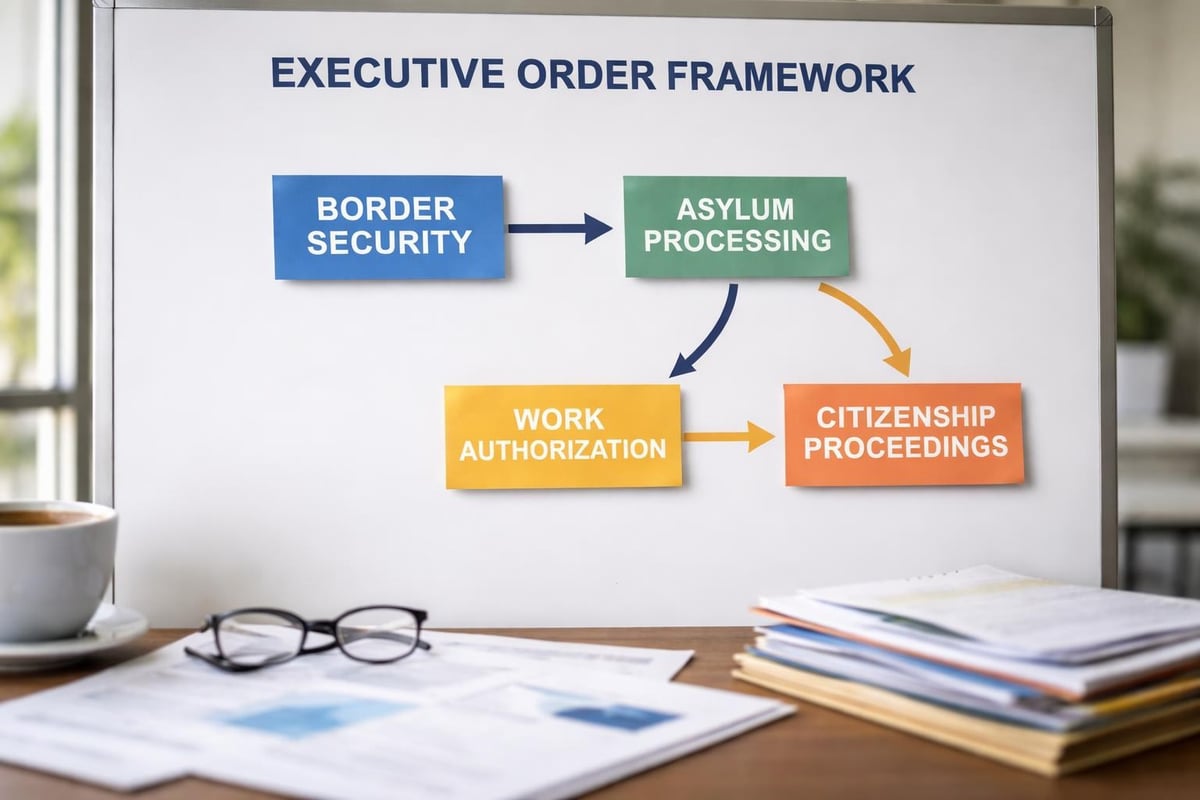
Several executive orders address border security, immigration enforcement, and national security concerns that remain priority issues for the administration.
Border Management
New directives implement enhanced border security measures including:
- Technology deployment for surveillance and monitoring
- Personnel increases at ports of entry
- Infrastructure improvements at processing facilities
- Coordination protocols between federal and state agencies
These orders complement legislative efforts while addressing immediate operational needs.
Immigration Processing
Executive orders streamline certain immigration procedures:
| Process | Previous Timeline | New Timeline | Change |
|---|---|---|---|
| Work visa adjudication | 6-8 months | 3-4 months | 50% reduction |
| Asylum hearing scheduling | 18-24 months | 12-15 months | 35% reduction |
| Citizenship applications | 12-18 months | 8-12 months | 33% reduction |
| Family reunification | 10-14 months | 6-9 months | 40% reduction |
For comprehensive coverage of these and other policy developments, presidents in the news provides ongoing analysis of how executive actions shape governance.
Legal and Constitutional Considerations
Every executive order faces potential legal scrutiny. The legal analysis provided by Snell & Wilmer examines constitutional boundaries and separation of powers questions.
Judicial Review Prospects
Several 2026 executive orders face or will likely face court challenges based on:
- Statutory authority: Whether existing laws grant the claimed executive power
- Administrative procedure: Compliance with notice-and-comment requirements
- Constitutional limits: Potential separation of powers or federalism concerns
- Prior precedent: How similar orders have been treated historically
Legal experts anticipate that approximately 15-20% of major executive orders will face substantive litigation.
Implementation Challenges
Federal agencies tasked with implementing these directives encounter various obstacles:
- Resource allocation for new programs
- Personnel training requirements
- Technology system modifications
- Stakeholder coordination across jurisdictions
- Timeline compression for compliance
The official White House repository provides full text and implementation guidance for all orders, serving as the authoritative source for agencies and the public.
Sector-Specific Impacts
This new executive orders summary 2026 demonstrates how presidential directives create cascading effects across American society. Different sectors experience varying degrees of impact depending on the orders' scope and specificity.
Healthcare Sector
Healthcare providers, insurers, and pharmaceutical companies navigate orders affecting:
- Medicare reimbursement rates and approval processes
- Drug pricing transparency and negotiation frameworks
- Telehealth service expansion and coverage mandates
- Healthcare workforce development and immigration pathways
Technology Industry
Tech companies face new requirements regarding:
- Data privacy and consumer protection standards
- Artificial intelligence development and deployment guidelines
- Cybersecurity protocols for government contractors
- Antitrust review procedures and merger approvals
Energy Sector
Energy producers and utilities respond to orders concerning:
- Renewable energy development on federal lands
- Traditional energy production permits and leases
- Grid modernization and infrastructure investment
- International energy partnership frameworks
Financial Services
Banks, credit unions, and investment firms adjust to orders addressing:
- Consumer protection in digital banking
- Cryptocurrency regulation and oversight
- Small business lending requirements
- Housing finance system modifications
Implementation Monitoring and Accountability
The effectiveness of executive orders depends on robust implementation and oversight mechanisms. Multiple entities track compliance and outcomes.
Congressional Oversight
Legislative branch oversight includes:
- Committee hearings on order implementation
- Appropriations decisions affecting order funding
- Potential legislative modifications or reversals
- Inspector general investigations into compliance
Public Transparency
Administration commitment to transparency manifests through:
- Quarterly implementation reports from federal agencies
- Public comment periods for regulatory changes
- Stakeholder engagement sessions
- Performance metrics and outcome tracking
- Independent audits of major initiatives
These accountability measures ensure that executive orders achieve intended objectives while respecting democratic norms and institutional constraints.
Future Outlook and Anticipated Orders
Based on administration priorities and current events, analysts anticipate additional executive orders addressing:
- Infrastructure project acceleration
- Artificial intelligence governance frameworks
- Workforce development and apprenticeship programs
- International trade agreement implementation
- Emergency preparedness and disaster response
The dynamic nature of governance means this new executive orders summary 2026 represents a snapshot of an evolving policy landscape. As circumstances change and new challenges emerge, the administration will continue exercising executive authority to advance its policy agenda.
Understanding these directives helps citizens, businesses, and organizations prepare for regulatory changes and policy shifts. Whether orders address immediate crises or long-term structural issues, their impact shapes American life in profound ways. Staying informed about presidential links and executive actions enables effective participation in democratic processes and informed decision-making.
Navigating the complex landscape of executive orders requires access to reliable, non-partisan information that helps you understand how presidential directives affect your life, business, and community. U.S. Presidential Report delivers comprehensive coverage of executive orders, presidential actions, and policy developments with the balanced perspective you need to stay informed about governance at the highest level.