Understanding the political party affiliations of American presidents provides crucial insight into the evolution of United States governance. The story of us presidents political party alignments reveals not just individual leaders, but the fundamental shifts in American political philosophy, coalition-building, and the two-party system that has dominated for nearly two centuries. From George Washington's warnings against partisan politics to today's deeply divided political landscape, presidential party affiliations have shaped domestic policy, foreign relations, and the very fabric of American democracy.
The Founding Era: Before Formal Party Systems
The earliest American presidents operated in a political environment vastly different from today's structured party system. George Washington, the nation's first president, held no official party affiliation and warned against the "baneful effects of the spirit of party" in his farewell address. Despite his non-partisan stance, Washington's administration saw the emergence of competing political factions that would eventually crystallize into formal parties.
John Adams became the first president affiliated with an organized political group when he represented the Federalist Party from 1797 to 1801. The Federalists, led by Alexander Hamilton and Adams, advocated for strong central government, commercial development, and closer ties with Britain. Their opposition, the Democratic-Republicans led by Thomas Jefferson and James Madison, championed states' rights, agricultural interests, and a more limited federal government.
The Democratic-Republican Dominance
Thomas Jefferson's election in 1800 marked what he called the "Revolution of 1800," establishing Democratic-Republican control that would last nearly three decades. This period saw five consecutive Democratic-Republican presidents:
- Thomas Jefferson (1801-1809)
- James Madison (1809-1817)
- James Monroe (1817-1825)
- John Quincy Adams (1825-1829)
- Andrew Jackson (1829-1837)
The Federalist Party gradually declined during this era, effectively disappearing after the War of 1812. James Monroe's presidency from 1817 to 1825 became known as the "Era of Good Feelings," characterized by minimal partisan conflict as the Federalists essentially ceased to exist as a national political force.
The Birth of Modern Political Parties
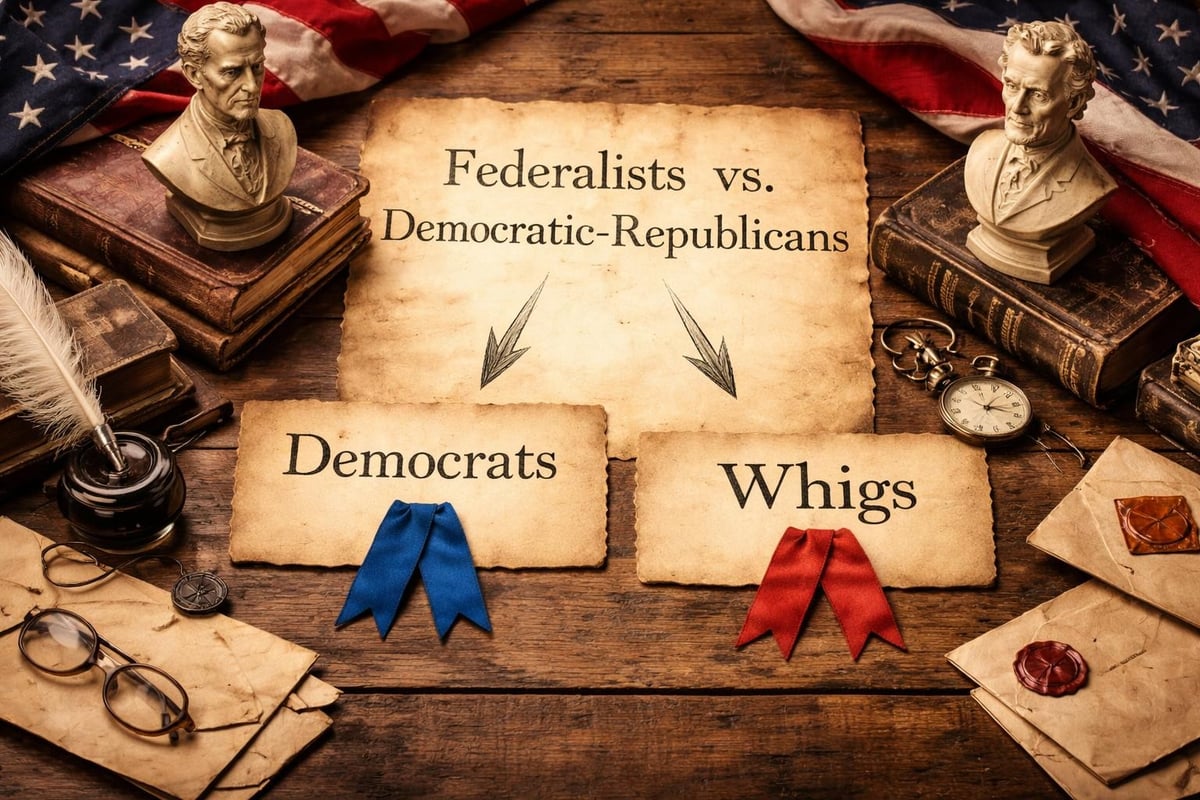
The us presidents political party landscape transformed dramatically in the 1820s and 1830s. Andrew Jackson's presidency marked the formation of what would become the modern Democratic Party, making him a pivotal figure in American political history. Jackson’s Democratic Party emerged from the Democratic-Republican Party's split, emphasizing populist principles and expanded voting rights for white male citizens.
Opposition to Jackson coalesced into the Whig Party in the 1830s, creating America's "Second Party System." The Whigs believed in congressional supremacy over the executive branch and supported modernization through banking and infrastructure development. This party system produced several presidents before its collapse in the 1850s over slavery disputes.
Whig Party Presidents
| President | Term | Key Achievements |
|---|---|---|
| William Henry Harrison | 1841 | Died after 31 days in office |
| John Tyler | 1841-1845 | Expelled from Whig Party during presidency |
| Zachary Taylor | 1849-1850 | Died in office after 16 months |
| Millard Fillmore | 1850-1853 | Last Whig president |
The Whig Party's inability to maintain unity on slavery ultimately led to its dissolution, creating space for new political alignments.
The Republican Party Emerges
The modern Republican Party was founded in 1854 as an anti-slavery coalition, fundamentally altering the us presidents political party dynamics for generations to come. Abraham Lincoln became the first Republican president in 1861, leading the nation through the Civil War and permanently associating the party with the preservation of the Union and the abolition of slavery.
The period from 1861 to 1913 saw Republican dominance, with only two Democratic presidents interrupting their control: Grover Cleveland and Woodrow Wilson. Cleveland holds the unique distinction of serving nonconsecutive terms as both the 22nd and 24th president, a historical precedent that remained singular until recent elections.
Republican presidents during this era oversaw:
- Reconstruction following the Civil War
- Industrial expansion and economic growth
- Western expansion and settlement
- America's emergence as a global power
The Republican Party's association with business interests, protective tariffs, and industrial development defined this period and established voting patterns that persisted for decades.
The 20th Century Party Realignment
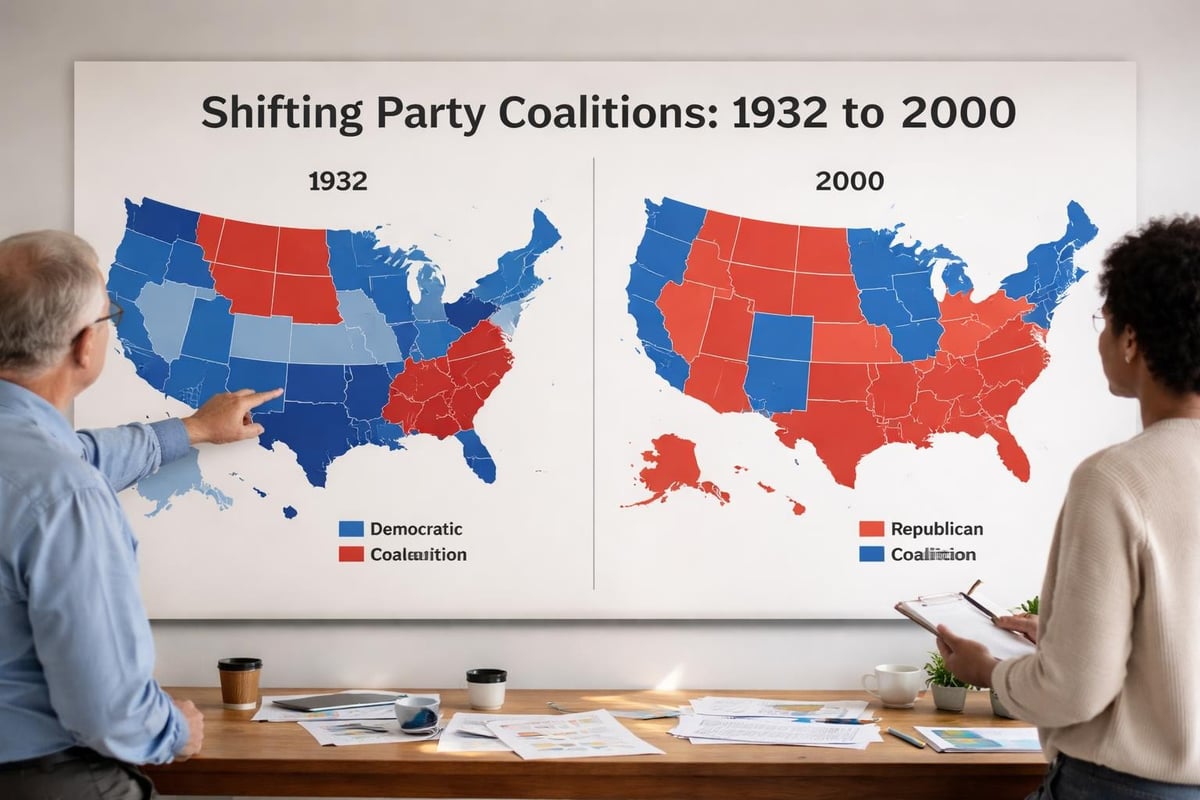
The 20th century brought significant shifts in us presidents political party ideology and coalition composition. The Democratic Party, which had been associated with the South and conservative positions on race, began transforming under Franklin D. Roosevelt's leadership in the 1930s. Roosevelt's New Deal coalition brought together urban workers, ethnic minorities, Southern Democrats, and progressive reformers.
Presidential Party Distribution (1901-2000)
The century saw relatively balanced party control:
Republican Presidents:
- Theodore Roosevelt, William Howard Taft, Warren Harding, Calvin Coolidge, Herbert Hoover, Dwight Eisenhower, Richard Nixon, Gerald Ford, Ronald Reagan, George H.W. Bush
Democratic Presidents:
- Woodrow Wilson, Franklin D. Roosevelt, Harry Truman, John F. Kennedy, Lyndon Johnson, Jimmy Carter, Bill Clinton
This period witnessed the "Southern Strategy" that realigned regional party loyalties, the civil rights movement that transformed Democratic Party principles, and economic philosophies that increasingly differentiated the parties. You can explore more about Bill Clinton’s presidency and its impact on modern Democratic politics through detailed coverage of his administration.
Contemporary Political Party Dynamics
The 21st century has intensified partisan divisions, making us presidents political party affiliations more predictive of policy positions than ever before. The political landscape from 2016 to present demonstrates unprecedented polarization, with sharp distinctions between Democratic and Republican approaches to governance, healthcare, climate policy, and international relations.
George W. Bush's Republican presidency (2001-2009) focused on:
- Post-9/11 security policies and the War on Terror
- Tax cuts and conservative economic policy
- Faith-based initiatives and social conservatism
- Appointments of conservative federal judges
Barack Obama's Democratic administration (2009-2017) pursued contrasting priorities including the Affordable Care Act, climate change initiatives, and progressive social policies. Donald Trump's presidency (2017-2021) represented a populist shift within the Republican Party, challenging traditional conservative orthodoxy on trade, foreign policy, and political norms.
Modern Party Platforms Comparison
| Issue Area | Democratic Position | Republican Position |
|---|---|---|
| Healthcare | Government expansion, universal coverage | Market-based solutions, private insurance |
| Climate Policy | Aggressive regulation, clean energy investment | Energy independence, limited regulation |
| Taxation | Progressive taxation, higher rates on wealthy | Lower taxes, supply-side economics |
| Immigration | Pathway to citizenship, refugee acceptance | Border security, enforcement emphasis |
| Foreign Policy | Multilateral engagement, international agreements | America First, selective engagement |
The 2024 Election and Beyond
The 2024 presidential election marked a historic rematch between major party candidates, reflecting the consolidated power of established political figures within both parties. This election cycle demonstrated how us presidents political party organizations have become more centralized and how primary voters increasingly select candidates aligned with their party's ideological base rather than moderate compromise builders.
Current trends affecting presidential party politics include:
- Increased polarization making crossover voting rare
- Primary systems that favor ideological purity
- Media fragmentation creating distinct information environments
- Demographic shifts altering traditional party coalitions
- Generational differences in party identification and loyalty
The role of vice presidential candidates has also evolved, with figures like Kamala Harris representing important coalition-building considerations for party tickets seeking to balance ideology, geography, gender, and demographic appeal.
Party Control and Policy Outcomes
The relationship between us presidents political party affiliation and actual policy implementation reveals important patterns about American governance. Presidents from the same party often pursue remarkably different approaches based on historical context, personal ideology, and congressional composition. A comprehensive overview of presidents and their parties demonstrates this variation across American history.
Unified vs. Divided Government Impact:
When presidents enjoy same-party control of Congress, they typically achieve:
- Greater legislative success rates
- More ambitious policy initiatives
- Faster confirmation of judicial and executive appointments
- Clearer party messaging and accountability
Divided government, conversely, often produces:
- Bipartisan compromise on select issues
- Gridlock on partisan priorities
- Increased use of executive orders
- Focus on administrative rather than legislative action
Research on party affiliation trends shows extended periods of single-party dominance followed by competitive eras, suggesting American voters periodically reassess which party better addresses contemporary challenges.
Foreign Policy and Party Differences
Presidential foreign policy reveals both partisan distinctions and surprising continuities across party lines. While us presidents political party affiliation influences diplomatic priorities, national security concerns often transcend partisan boundaries. The U.S. presidential policy on war demonstrates how both Democratic and Republican administrations have navigated international conflicts.
Democratic Foreign Policy Traditions:
- Emphasis on international institutions and alliances
- Multilateral diplomatic engagement
- Human rights as foreign policy consideration
- Arms control and nuclear nonproliferation
Republican Foreign Policy Traditions:
- Military strength and defense spending
- Bilateral rather than multilateral agreements
- National sovereignty prioritization
- Strategic relationships based on security interests
However, individual presidents often deviate from these patterns based on circumstances, advisors, and personal conviction. Richard Nixon's opening to China, Jimmy Carter's human rights focus, Ronald Reagan's arms reduction negotiations, and George W. Bush's democracy promotion all represented departures from partisan orthodoxy.
Third Parties and Independent Challenges
While the two major parties have dominated us presidents political party history, third-party and independent candidates have occasionally influenced presidential elections. No third-party candidate has won the presidency since the Republican Party's emergence in the 1850s, but several have affected electoral outcomes:
- Theodore Roosevelt's Progressive ("Bull Moose") Party in 1912 split Republican votes
- George Wallace's American Independent Party in 1968 won five Southern states
- Ross Perot's independent campaigns in 1992 and 1996 captured significant popular vote percentages
- Ralph Nader's Green Party candidacy in 2000 potentially affected Florida's outcome
The American electoral system's winner-take-all structure and the Electoral College make third-party presidential victories extremely difficult, reinforcing the two-party dominance that has characterized most of American history.
The Democratic Party's Presidential Legacy
The Democratic Party has undergone profound transformations while maintaining certain core commitments throughout its history. From Andrew Jackson's populism through Franklin Roosevelt's New Deal to modern progressive politics, Democratic presidents have shaped American society through:
Key Democratic Presidential Achievements:
- Social Security and Medicare establishment
- Civil Rights Act and Voting Rights Act
- Environmental Protection Agency creation
- Affordable Care Act implementation
- Minimum wage increases and labor protections
Modern Democratic presidents have increasingly emphasized social justice, environmental protection, and economic equality, representing coalitions of urban voters, minorities, young people, and college-educated professionals.
The Republican Party's Presidential Legacy
Republican presidents have similarly evolved while maintaining philosophical commitments to limited government, individual liberty, and free-market economics. The party's transformation from its anti-slavery origins to modern conservatism reflects changing American society and political realignments.
Key Republican Presidential Achievements:
- Emancipation Proclamation and constitutional amendments ending slavery
- Interstate Highway System development
- Cold War victory and Soviet Union collapse
- Tax reform and economic deregulation
- Conservative judicial appointments reshaping federal courts
Contemporary Republican presidents emphasize constitutional originalism, traditional values, business-friendly policies, and strong national defense, drawing support from rural areas, evangelical Christians, business owners, and military communities.
Presidential Libraries and Historical Records
Understanding us presidents political party affiliations and their impact requires examining historical documentation. Presidential library information provides researchers, journalists, and citizens access to archival materials that illuminate how party politics influenced decision-making. These repositories preserve documents, correspondence, and artifacts that reveal the relationship between partisan identity and presidential action.
Each presidential library offers insights into:
- Campaign strategies and party platform development
- Relationships with party leadership and congressional allies
- Internal debates over policy priorities
- Political calculations behind major decisions
- Evolution of party ideology during each administration
These historical resources enable deeper understanding of how party affiliation has shaped American governance across different eras and circumstances.
The evolution of us presidents political party affiliations tells the broader story of American democracy, revealing how political coalitions form, fracture, and reform in response to changing national challenges. Understanding these party dynamics provides essential context for evaluating current political debates and anticipating future developments. For comprehensive, non-partisan coverage of presidential politics past and present, U.S. Presidential Report delivers the latest news and historical analysis to help readers navigate America's complex political landscape with clarity and insight.